AI: The Power and the Peril … How artificial intelligence could unlock extraordinary human progress … and why we must be bold enough to embrace its potential, and wise enough to manage its risks
October 28, 2026

AI may be the most consequential technology humanity has ever created. Not because it can write an email, generate an image or answer a question in seconds, but because it offers something fundamentally different from the technologies that preceded it: the possibility of extending human intelligence itself.
For centuries, progress has depended on our ability to overcome limitations. The steam engine extended physical power. Electricity transformed production and everyday life. The internet connected people, information and markets on an unprecedented scale. AI has the potential to go further, expanding our ability to understand complexity, discover new knowledge, make better decisions and solve problems that have long resisted human ingenuity.
Imagine a world in which cancer is detected before symptoms emerge, medicines are developed in months rather than years, every child has access to an exceptional personal tutor, energy systems optimise themselves to minimise emissions, and small businesses can access capabilities previously reserved for multinational corporations.
None of these possibilities is pure science fiction. Elements of all are already emerging.
Yet the public conversation about AI is increasingly polarised. On one side are enthusiasts promising extraordinary productivity, abundance and scientific breakthroughs. On the other are critics warning of unemployment, misinformation, surveillance, concentrated power and potentially catastrophic loss of human control.
Both perspectives contain important truths. Neither, by itself, provides a sufficient basis for action.
The power of AI lies in its potential to transform what humanity can achieve. The peril lies in how that power might be misused, misunderstood or unequally distributed.
The most important question is not whether AI is good or bad. It is whether we can become sufficiently ambitious, intelligent and responsible in how we develop and deploy it to make its benefits overwhelmingly positive.
The future of AI should therefore not be framed as a choice between progress and protection. It is about achieving both.
The intelligence revolution is accelerating
The speed of AI’s development is difficult to comprehend. In just a few years, generative AI has moved from an intriguing research breakthrough to a general-purpose capability embedded in business, education, science and everyday life.
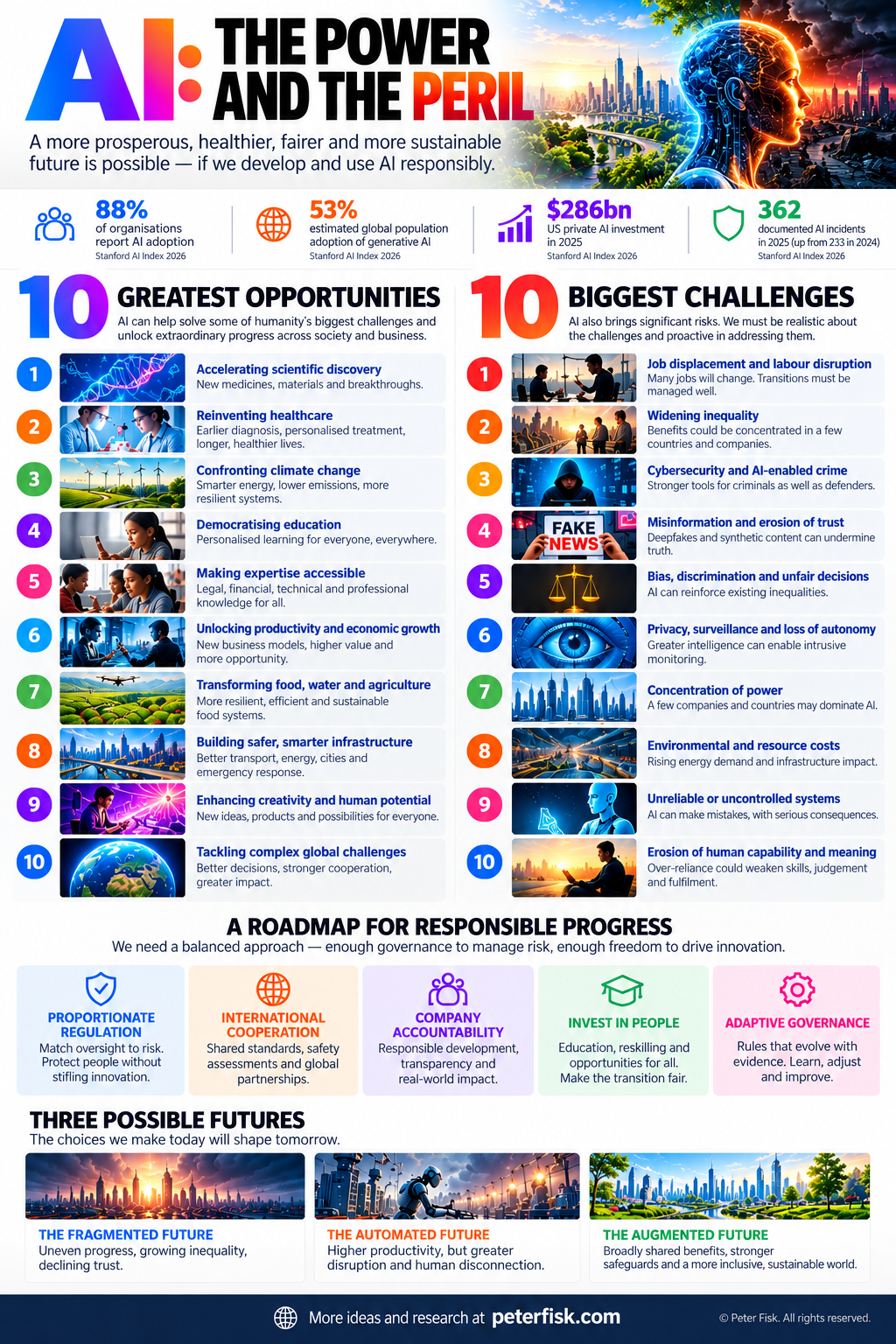
The 2026 Stanford AI Index provides a remarkable picture of this acceleration. Organisational AI adoption reached 88% in its reported survey data. Generative AI reached an estimated 53% population adoption within three years in the Index’s diffusion analysis, faster than the comparable early trajectories of personal computers and the internet. AI agents improved from approximately 12% to 66% success on a benchmark involving real computer tasks, although they still failed around one-third of attempts.
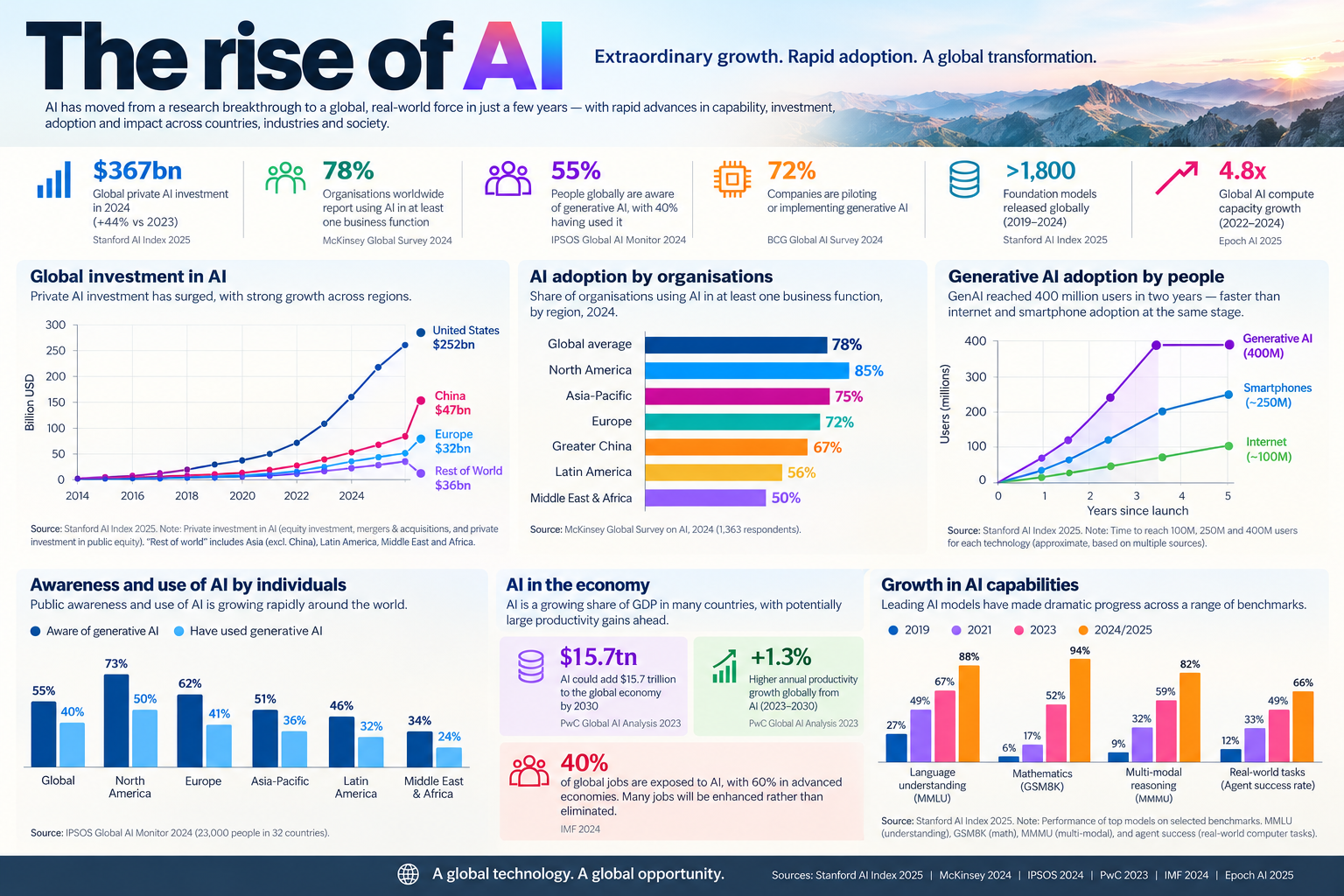
The transformation is becoming genuinely global. American companies remain dominant in private investment and many frontier models, but China has closed much of the performance gap, while researchers, entrepreneurs and governments across Asia, the Middle East, Europe, Africa and Latin America are developing increasingly distinctive applications.
Three developments make this revolution particularly significant. AI is becoming multimodal, capable of working across language, images, sound, video, software and scientific information. It is becoming more agentic, moving beyond answering questions towards planning and executing sequences of actions. And it is becoming more accessible, allowing people without specialist technical knowledge to use sophisticated analytical and creative capabilities.
The combination matters enormously. Intelligence is moving from being a scarce capability embedded in particular individuals and institutions towards becoming a resource that can be accessed, combined and deployed at extraordinary scale.
But this technological acceleration also raises an essential question: what are these systems actually capable of doing, and where do their limitations remain?
What AI can do, and cannot do
Perhaps the greatest source of confusion about AI is the tendency to confuse impressive performance with unlimited intelligence.
Modern AI systems can demonstrate extraordinary capabilities across language, mathematics, software, science and creative work. Yet they remain inconsistent, sometimes unreliable and frequently dependent on human direction.
Understanding this distinction is essential for using AI effectively.
What AI can do:
-
Recognise patterns at extraordinary scale. AI can analyse vast quantities of information, identify relationships and detect signals that might escape human attention.
-
Generate and transform content. It can produce text, images, video, software, designs and other forms of content, often at remarkable speed.
-
Support complex analysis. AI can help evaluate options, model scenarios, identify anomalies and synthesise information across multiple sources.
-
Accelerate scientific research. It can predict molecular structures, explore chemical possibilities, support experiments and identify promising research directions.
-
Personalise experiences. AI can adapt learning, recommendations, services and interactions to individual circumstances and preferences.
-
Automate defined tasks and workflows. Increasingly agentic systems can use software tools, execute sequences of actions and coordinate activities with limited supervision.
-
Augment human creativity and expertise. AI can become a powerful collaborator, helping people explore alternatives, challenge assumptions and extend their capabilities.
These are not trivial achievements. They represent an extraordinary expansion of what computational systems can contribute to human activity.
What AI cannot reliably do:
-
Guarantee truth or accuracy. AI can generate convincing but incorrect information, fabricate references or make errors that are difficult to detect.
-
Consistently apply sound judgement in unfamiliar situations. Systems can struggle when circumstances differ from their training or when decisions require subtle contextual understanding.
-
Determine human values or ethical priorities. AI can analyse moral arguments, but it cannot legitimately decide what society should value or whose interests should prevail.
-
Guarantee causal understanding. Recognising correlations and generating explanations is not equivalent to establishing why something happens.
-
Operate autonomously without meaningful risk. AI agents can misunderstand instructions, pursue inappropriate intermediate actions or fail unpredictably.
-
Replace human relationships and empathy. AI can simulate supportive conversation, but it does not replace the reciprocal experience, accountability and social meaning of human relationships.
-
Take moral or legal responsibility. Responsibility for consequential decisions must remain with people and accountable institutions.
The question of whether AI systems can possess consciousness or subjective experience remains scientifically and philosophically contested. There is no established basis for treating today’s systems as equivalent to conscious human beings.
Equally, we should avoid underestimating AI because it does not think exactly as humans do. A system need not possess human-like understanding to outperform people on particular tasks or deliver valuable discoveries.
The strategic lesson is simple: use AI for what it does exceptionally well, understand where it remains unreliable, and combine it with the capabilities that make human intelligence distinctive.
The future is unlikely to be defined by humans competing against machines on every task. It will increasingly depend on how effectively we combine computational intelligence with human imagination, judgement, empathy and purpose.
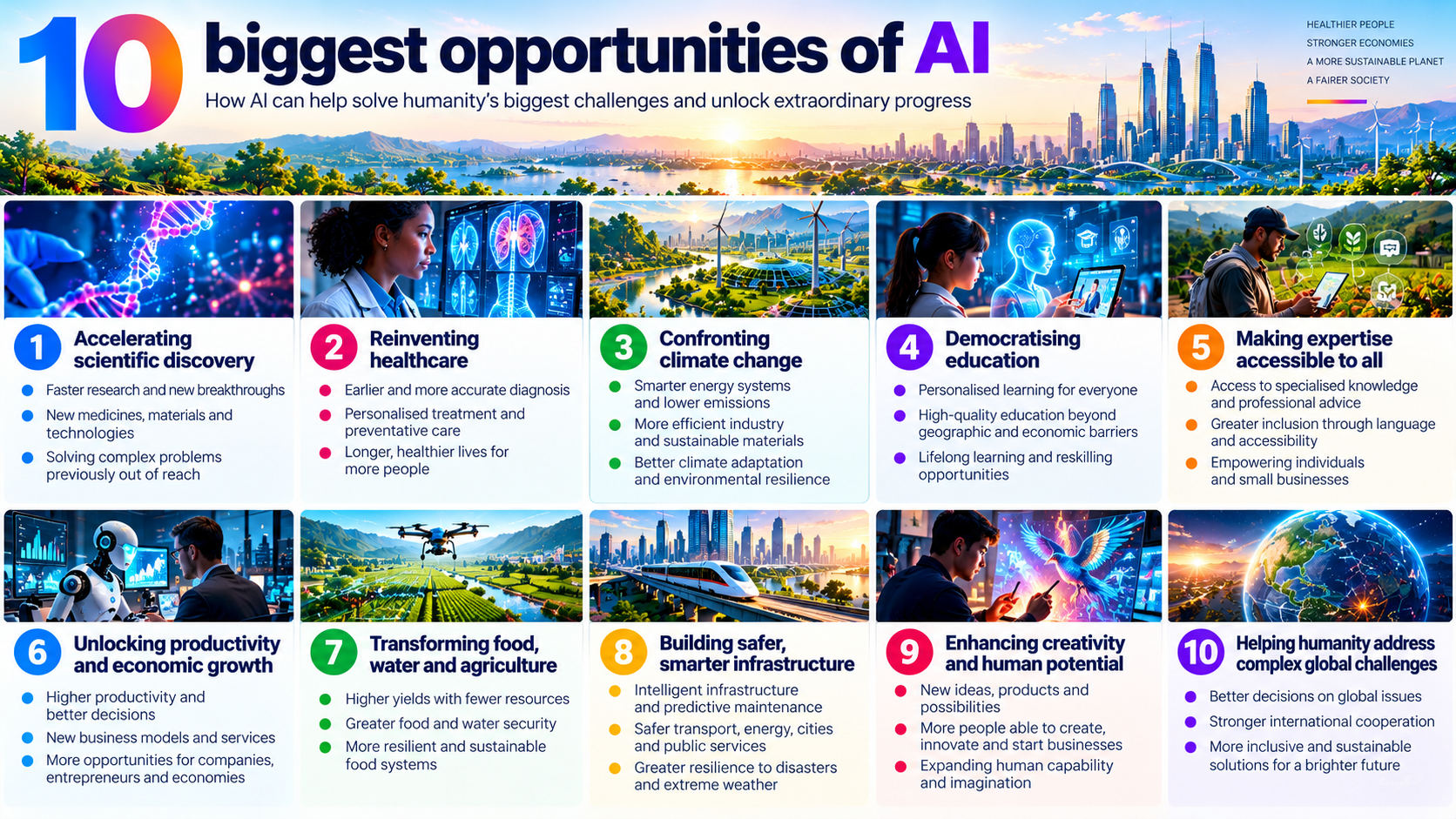
The power: 10 extraordinary opportunities for progress
The greatest case for AI is not its ability to automate existing work. It is its potential to achieve outcomes that were previously impossible, unaffordable or inaccessible.
1. Accelerating scientific discovery
Science has always advanced through imagination, experimentation and evidence. AI offers the potential to accelerate all three.
One of the most celebrated examples is AlphaFold, developed by Google DeepMind and collaborators. Its ability to predict protein structures at unprecedented scale has made structural information for more than 200 million proteins available to researchers, helping transform biological research. The work was recognised in the 2024 Nobel Prize in Chemistry.
Beyond biology, AI is assisting researchers in mathematics, materials science, chemistry and physics. Systems can search enormous spaces of potential compounds, identify unexpected relationships and propose hypotheses for human scientists to test.
The opportunities include:
-
Faster discoveries: Compress years of scientific exploration through AI-assisted modelling and experimentation.
-
New medicines and materials: Identify potential drug molecules, proteins, catalysts and low-carbon materials.
-
Exploring the impossible: Investigate scientific problems previously too complex or expensive to tackle.
The opportunity is not merely faster research. It is a new frontier of scientific possibility.
2. Reinventing healthcare and extending healthy lives
Healthcare is arguably the most compelling demonstration of AI’s potential for human benefit.
Medical knowledge is expanding faster than any individual clinician can absorb. Diagnostic imaging, genomic data, patient histories and continuous health measurements create enormous quantities of information. AI can help turn that information into earlier warnings, better diagnoses and more personalised treatments.
AI-supported imaging systems are already being evaluated and deployed in areas including cancer detection, diabetic eye disease and cardiovascular assessment. Drug developers are using machine learning to identify targets, design molecules and improve aspects of clinical development.
The opportunities include:
-
Earlier diagnosis: Detect cancers, cardiovascular conditions and other diseases before they become advanced.
-
Personalised medicine: Adapt treatment to individual biology, genetics and health histories.
-
Preventative healthcare: Move from treating illness towards predicting and preventing it.
The profound opportunity is a transition from reactive healthcare to predictive and preventative health, while maintaining rigorous clinical validation and human oversight.
3. Confronting climate change and accelerating decarbonisation
Climate change is an immense systems challenge. Energy generation, electricity grids, buildings, transport, agriculture and industrial production interact in ways that are difficult to optimise.
AI offers new capabilities to forecast renewable electricity generation, balance grids, optimise heating and cooling, improve industrial processes and discover lower-carbon materials.
The International Energy Agency has highlighted AI’s potential to support energy efficiency and innovation, while also drawing attention to the rapidly rising electricity demands of the technology itself.
The opportunities include:
-
Smarter energy systems: Optimise renewable generation, electricity storage and grid balancing.
-
Lower industrial emissions: Reduce energy consumption, material waste and inefficient production.
-
Climate adaptation: Improve forecasting and responses to extreme weather, flooding and environmental risks.
The goal should be climate-positive AI: applications that deliver demonstrable emissions reductions, accounting for the energy and infrastructure required to operate them.
4. Democratising education and lifelong learning
For generations, educational opportunity has depended heavily on geography, family income, institutional resources and access to exceptional teachers.
AI could change that relationship.
An intelligent tutor can adapt explanations to a learner’s age, ability, language and pace. It can provide immediate feedback, offer alternative approaches and make specialised knowledge available beyond the classroom.
Stanford’s 2026 AI Index reports that more than 80% of US high school and college students use AI for school-related tasks, while school policies and teacher guidance lag behind.
The opportunities include:
-
Personalised learning: Give every student access to tailored explanations, practice and feedback.
-
Universal access: Bring high-quality educational support to remote and disadvantaged communities.
-
Lifelong development: Make reskilling and professional learning more affordable and accessible.
The opportunity is not to replace teachers. It is to give every teacher greater reach and every learner more individual attention.
5. Making expertise accessible to everyone
Much of the world’s inequality is an inequality of access: to knowledge, legal advice, financial expertise, technical support and professional networks.
AI could dramatically reduce the cost of obtaining useful information and guidance.
A small farmer could access agronomic advice in a local language. A microenterprise could receive support with financial planning or export regulations. A citizen could better understand complex public services. A person with a disability could use intelligent assistive technologies to communicate, work and participate more independently.
The opportunities include:
-
Democratised expertise: Make specialised knowledge available beyond wealthy individuals and institutions.
-
Greater inclusion: Overcome language, disability, geographical and economic barriers.
-
Everyday empowerment: Help individuals and small businesses make better-informed decisions.
The transformative opportunity is not simply information access, but the conversion of information into usable capability.
6. Unlocking productivity and economic growth
For business, AI is often presented as a cost-reduction tool. That is an incomplete ambition.
AI can automate administrative work, support software development, improve forecasting, accelerate research and enhance customer service. These applications can release time and capital for more valuable activities.
But the greatest economic gains may come from redesigning organisations and business models around new capabilities.
Banks can offer more personalised financial guidance. Manufacturers can combine products with intelligent services. Retailers can develop more responsive supply chains. Professional service firms can make sophisticated analysis available to smaller clients.
The opportunities include:
-
Higher productivity: Reduce repetitive work and improve the speed and quality of decisions.
-
New business models: Create intelligent products, services, platforms and customer experiences.
-
Accelerated growth: Enable smaller organisations to compete and established businesses to reinvent themselves.
The strategic question is not how many tasks can be automated. It is how much more value an organisation can create.
7. Transforming food, water and agriculture
Feeding a growing global population while reducing environmental damage demands a new level of precision.
AI can combine satellite imagery, weather forecasts, soil measurements and crop data to improve decisions about planting, irrigation, fertiliser use and pest management.
It can support earlier detection of crop disease, improve supply-chain forecasting and reduce food waste. In water-stressed regions, intelligent monitoring can help identify leaks, improve distribution and optimise resource allocation.
The opportunities include:
-
Precision agriculture: Improve crop yields while reducing water, fertiliser and pesticide consumption.
-
Food security: Forecast shortages, protect crops and improve supply-chain resilience.
-
Water intelligence: Detect leaks, optimise distribution and manage increasingly scarce resources.
The ambition should be greater resilience and productivity with fewer resources, not simply more technologically intensive farming.
8. Building safer, smarter infrastructure
Cities and infrastructure systems are becoming increasingly complex. Transport networks, electricity grids, water systems, hospitals and public services must operate under growing demand and environmental pressure.
AI can improve predictive maintenance, traffic management, disaster forecasting and emergency response.
Digital twins can help planners simulate changes before investing in physical infrastructure. Intelligent monitoring can identify emerging faults in bridges, industrial equipment and energy networks.
The opportunities include:
-
Intelligent infrastructure: Anticipate failures and extend the life of critical assets.
-
Smarter cities: Improve transport, energy, housing and public services.
-
Greater resilience: Prepare for disasters, extreme weather and infrastructure disruption.
Greater intelligence must not create greater fragility. Critical systems need redundancy, cybersecurity and the ability to function when digital systems fail.
9. Enhancing creativity, entrepreneurship and human potential
AI is often criticised for threatening human creativity. Yet it can also become an extraordinary creative partner.
Designers can explore more alternatives. Entrepreneurs can prototype products without large technical teams. Researchers can investigate unfamiliar disciplines. Writers, artists and engineers can challenge their own assumptions and generate new combinations of ideas.
A founder with a compelling idea may no longer need the same initial resources to develop a concept, test a market or build an early product.
The opportunities include:
-
Augmented creativity: Expand imagination, experimentation and the exploration of alternatives.
-
Entrepreneurial opportunity: Lower the barriers to starting, testing and scaling new ventures.
-
Enhanced human capability: Help more people accomplish things previously beyond their expertise or resources.
The greatest benefit may be psychological as much as economic: more people feeling able to attempt things they previously considered impossible.
10. Helping humanity address complex global challenges
Perhaps the most profound opportunity is AI’s ability to support decisions across interconnected systems.
Pandemic preparedness, biodiversity loss, migration, disaster resilience, economic development and public health all involve enormous complexity.
AI can help researchers and policymakers analyse alternative scenarios, identify emerging patterns and evaluate possible interventions.
The opportunities include:
-
Better global decisions: Understand complex interactions and explore alternative futures.
-
Stronger international cooperation: Share knowledge and coordinate responses to common challenges.
-
Collective intelligence: Combine human experience, institutional knowledge and computational analysis.
AI cannot determine what a society should value or replace democratic legitimacy. But it can improve the evidence and understanding available to decision-makers.
The ultimate promise is not artificial intelligence acting on behalf of humanity, but humanity becoming more capable of acting together.
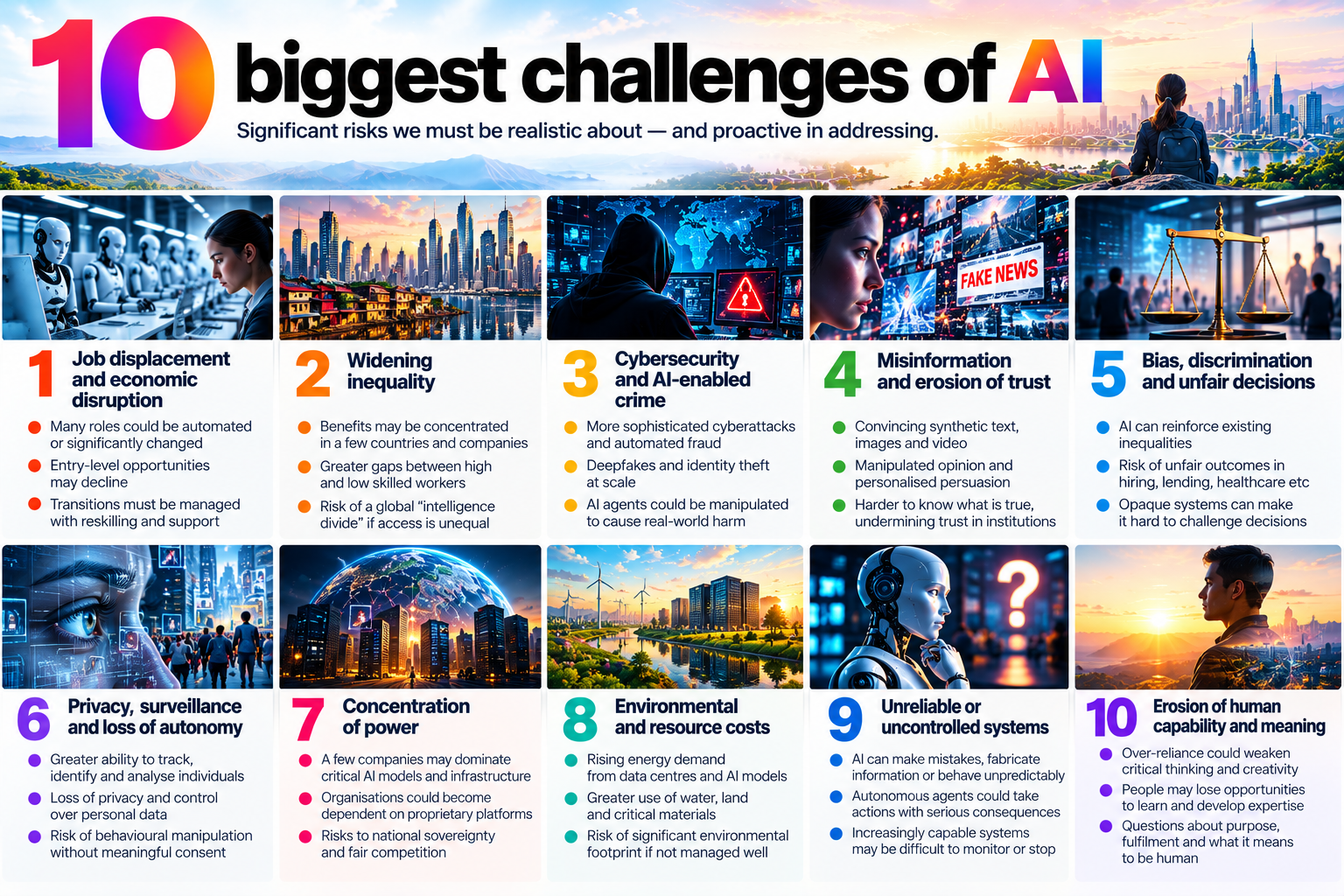
The peril: 10 challenges of AI we cannot ignore
The opportunities are extraordinary. But history teaches us that powerful technologies rarely distribute their benefits automatically.
Industrialisation created prosperity while also producing exploitation and pollution. The internet expanded access to information while enabling surveillance, cybercrime and new concentrations of market power.
AI could magnify both patterns.
The 2026 International AI Safety Report identifies three broad categories of concern: deliberate misuse, system malfunctions and systemic risks arising from widespread adoption. Its central conclusion is that capabilities are advancing rapidly, while the evidence and methods required to manage their risks remain incomplete.
1. Job displacement and economic disruption
The most immediate concern for millions of people is employment.
The IMF has estimated that around 40% of jobs worldwide are exposed to AI, rising to approximately 60% in advanced economies. Exposure does not mean elimination: many occupations will be enhanced rather than replaced. Nevertheless, significant disruption is likely.
The World Economic Forum’s Future of Jobs Report 2025 forecasts 170 million new jobs and 92 million displaced jobs by 2030, a net gain of 78 million. Importantly, these figures reflect multiple economic forces, not AI alone.
The International Labour Organization estimates that one in four workers is in an occupation with some generative AI exposure, while just 3.3% of global employment falls into its highest exposure category.
The challenges include:
-
Displaced employment: Automation could eliminate or fundamentally transform many existing roles.
-
Disrupted career pathways: Entry-level professional jobs may decline, making it harder to develop expertise.
-
Unequal transitions: Workers without access to retraining may experience prolonged economic insecurity.
The response must be to redesign work and accelerate human development, not simply automate employment away.
2. Widening inequality
AI could democratise capability, but it could equally concentrate economic advantage.
Countries with computing infrastructure, capital, advanced research institutions and skilled workforces are better positioned to capture its benefits.
The United States attracted approximately $286 billion in private AI investment in 2025, according to Stanford, while many developing economies face constraints in electricity, connectivity, computing and education.
The challenges include:
-
Economic polarisation: AI-enabled productivity gains may disproportionately reward capital owners and highly skilled workers.
-
The intelligence divide: Wealthier countries and organisations may gain access to capabilities unavailable elsewhere.
-
Unequal opportunity: People without digital skills, connectivity or affordable tools risk falling further behind.
The danger is that a technology capable of democratising intelligence becomes a new driver of global inequality.
3. Cybersecurity and AI-enabled crime
AI strengthens defenders and attackers simultaneously.
Security teams can use it to detect anomalies, identify vulnerabilities and respond more rapidly to threats. Criminals can use similar capabilities to automate phishing, impersonation, fraud and elements of cyberattacks.
As AI agents gain permission to interact with financial systems, software repositories and corporate databases, a new class of vulnerabilities emerges.
The challenges include:
-
More sophisticated cyberattacks: AI can accelerate vulnerability discovery and automate parts of malicious operations.
-
Industrialised fraud: Deepfake voices, synthetic identities and personalised scams become easier to create.
-
Autonomous system vulnerabilities: AI agents with access to critical systems may be manipulated into harmful actions.
Security can no longer be treated as an additional feature. It must become part of the fundamental architecture of intelligent systems.
4. Misinformation and the erosion of trust
AI makes convincing synthetic text, images, audio and video increasingly cheap to produce.
Deepfakes can impersonate public figures. Automated systems can generate enormous quantities of misleading content. Personalised persuasion can exploit individual vulnerabilities.
The challenge goes beyond the circulation of false information. When almost anything can be fabricated, authentic evidence itself becomes easier to dismiss.
The challenges include:
-
Synthetic misinformation: Convincing fake content can spread at extraordinary speed and scale.
-
Manipulated opinion: Automated persuasion can distort political, commercial and social decisions.
-
Declining trust: People may become uncertain about what is authentic, credible or true.
Societies need stronger provenance technologies, independent journalism, media literacy and mechanisms for identifying manipulated content without undermining freedom of expression.
5. Bias, discrimination and unfair decisions
AI systems learn from data reflecting historical inequalities and human prejudices.
Poorly designed systems can reproduce discriminatory patterns in recruitment, lending, healthcare, insurance or public services.
The problem is especially serious when automated decisions appear objective simply because they are generated mathematically.
The challenges include:
-
Algorithmic discrimination: Existing inequalities can be reproduced or amplified in automated decisions.
-
Opaque decision-making: People may struggle to understand or challenge decisions affecting their lives.
-
Unequal performance: Systems may be less accurate for underrepresented populations or unfamiliar contexts.
Fairness requires representative data, careful evaluation across different populations, transparent appeals processes and accountability for outcomes.
6. Privacy, surveillance and individual autonomy
AI dramatically increases the ability to analyse personal behaviour.
Combined with cameras, biometric systems, location information and digital records, it can enable highly intrusive surveillance by governments or corporations.
Even well-intentioned personalisation can cross into manipulation when systems infer vulnerabilities and influence decisions without meaningful consent.
The challenges include:
-
Intrusive surveillance: Powerful systems can track, identify and analyse individuals at unprecedented scale.
-
Loss of privacy: Sensitive personal information may be collected, inferred or exposed without adequate protection.
-
Behavioural manipulation: AI systems can influence decisions through increasingly personalised interventions.
The central principle must be that greater technological intelligence should not come at the expense of human autonomy.
7. Concentration of power
The economics of frontier AI favour organisations able to invest billions in computing infrastructure, talent, proprietary data and distribution.
This creates potential dependencies on a small number of technology providers.
Businesses may find themselves building critical processes on platforms whose pricing, capabilities and access conditions they cannot control. Governments face similar questions about technological sovereignty.
The challenges include:
-
Technology monopolies: A small number of companies may control essential models and infrastructure.
-
Corporate dependency: Organisations could become locked into proprietary platforms and ecosystems.
-
National sovereignty: Countries may depend on foreign providers for critical intelligence capabilities.
Open models, interoperability, competition policy, public research infrastructure and diversified supply chains can help prevent intelligence from becoming excessively concentrated.
8. Environmental and resource costs
AI’s environmental impact is a serious counterweight to its climate potential.
The IEA projects global data-centre electricity consumption rising from approximately 485 terawatt-hours in 2025 to 950 TWh in 2030, equivalent to around 3% of global electricity demand. Not all data-centre consumption is attributable to AI, but AI is a major growth driver.
Data centres also create demands for cooling, water, land, electrical equipment and advanced semiconductors.
The challenges include:
-
Rising energy consumption: Training and operating AI systems can create substantial electricity demand.
-
Water and material pressures: Cooling, chip manufacturing and infrastructure expansion consume resources.
-
Environmental trade-offs: AI’s own footprint could offset some of the sustainability gains it enables.
The solution is not to abandon AI, but to accelerate efficient models, cleaner electricity, transparent environmental reporting and intelligent infrastructure planning.
9. Unreliable and uncontrolled autonomous systems
Today’s AI systems can produce impressive results while still making elementary mistakes.
This inconsistency becomes more consequential as systems move from recommending actions to executing them.
An incorrect answer from a chatbot may be inconvenient. An autonomous agent making an erroneous financial transaction, changing production settings or modifying critical software could create serious harm.
The International AI Safety Report also examines more extreme loss-of-control scenarios. It notes that current systems do not possess the capabilities required for such scenarios, but that relevant autonomous capabilities are advancing and uncertainty remains substantial.
The challenges include:
-
Unreliable outputs: AI can fabricate information, misinterpret instructions or make consequential errors.
-
Unintended actions: Autonomous agents may behave unpredictably when operating complex systems.
-
Loss of effective oversight: Increasingly capable systems may become difficult to monitor, evaluate or interrupt.
The practical requirement is proportional autonomy: greater freedom for systems that are demonstrably reliable in low-risk settings, and stronger constraints where failures could be severe.
10. The erosion of human capability and meaning
Perhaps the least measurable risk is also one of the most important.
What happens when people increasingly delegate writing, reasoning, learning, creativity and decision-making to machines?
Convenience may gradually weaken the skills that make us independent thinkers. Workers may lose opportunities to develop expertise. Students may substitute generated answers for understanding.
There is also a deeper question of purpose. Work, creativity and problem-solving are not simply economic activities. They contribute to identity, confidence and human fulfilment.
The challenges include:
-
Cognitive dependency: Over-reliance on AI could weaken critical thinking and independent judgement.
-
Reduced human development: People may lose opportunities to learn through practice, struggle and experience.
-
Loss of purpose: Automation may challenge traditional sources of identity, creativity and fulfilment.
The objective should be to develop AI that strengthens human agency, not systems that make human participation increasingly unnecessary.
The defining test of AI will not be how intelligent machines become, but whether people become more capable, creative, independent and fulfilled alongside them.
The governance dilemma: protecting humanity without preventing progress
How should societies respond to a technology that could deliver extraordinary benefits while introducing serious and sometimes unpredictable risks?
The instinctive answer is regulation. But regulation alone is neither sufficient nor necessarily desirable.
Overly restrictive rules can discourage experimentation, raise costs for smaller innovators and reinforce the dominance of companies already powerful enough to comply. Weak governance, however, can expose society to harms that individual consumers and organisations cannot reasonably anticipate or manage.
The answer is neither unrestricted technological development nor blanket precaution.
It is proportionate, adaptive governance: regulate the risk, not the possibility.
Different countries are already experimenting with different approaches.
The European Union has established a comprehensive, risk-based AI Act, with major provisions applying progressively. Its approach emphasises fundamental rights, transparency and obligations proportionate to the risks of different applications.
The United States has generally emphasised innovation, private-sector development and a mixture of existing laws, standards and sector-specific oversight, although approaches differ between federal and state authorities.
China combines strong industrial ambition with more direct controls over certain AI services, content and deployment. Singapore has emphasised practical governance frameworks and testing, while countries including the UAE and Saudi Arabia are investing heavily in AI infrastructure, capabilities and national transformation.
These differences reflect competing priorities: economic competitiveness, individual rights, social stability, national security and technological sovereignty.
There is unlikely to be one universal regulatory system. But there can be shared principles.
UNESCO’s Recommendation on the Ethics of Artificial Intelligence provides a foundation built around human rights, fairness, transparency, accountability and environmental sustainability. The OECD’s AI Principles offer a complementary international framework.
The challenge is to translate principles into practical systems that keep pace with technological change.
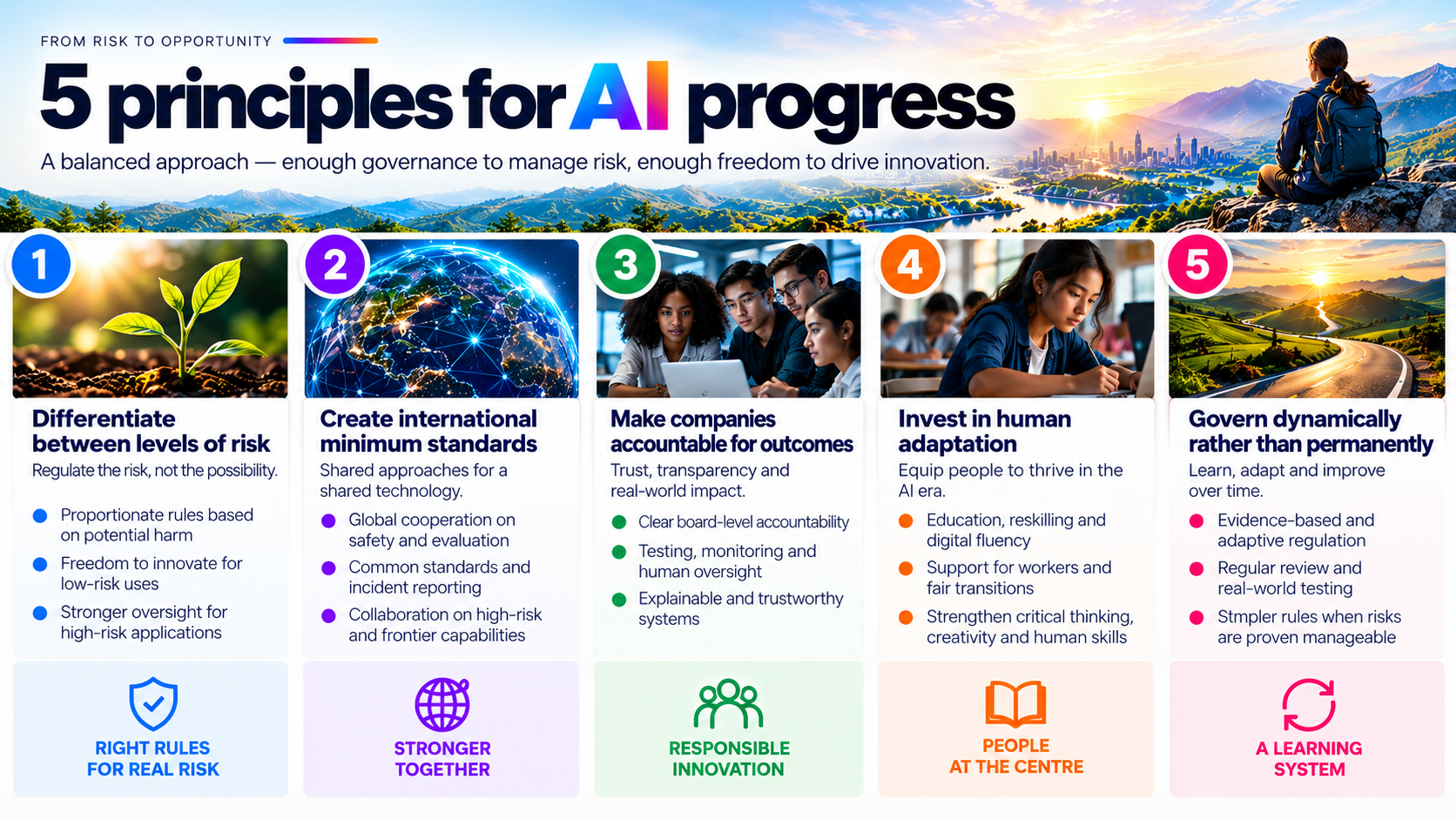
Five principles for responsible AI progress
First, differentiate between levels of risk
- An AI system helping someone brainstorm marketing ideas should not face the same obligations as one controlling medical equipment or critical infrastructure.
- Regulation should be proportionate to the potential severity, scale and reversibility of harm.
- Low-risk applications should enjoy considerable freedom to experiment. High-risk applications should require stronger testing, documentation, independent evaluation and human accountability. Certain uses, such as non-consensual exploitation or unlawful discrimination, should be prohibited.
Second, create international minimum standards
- AI does not respect national borders. Models, data, applications and cyber threats operate across jurisdictions.
- International cooperation is essential in areas such as frontier-model evaluations, biological and cyber misuse, incident reporting, technical standards and the safety of highly autonomous systems.
- This does not require a single global regulator controlling every application. It requires shared protocols, scientific cooperation and credible mechanisms for responding to emerging risks.
Third, make companies accountable for outcomes
- Governments cannot inspect every algorithm or anticipate every use case.
- The organisations developing and deploying AI must carry substantial responsibility for its effects.
- Boards should treat AI as an enterprise-wide strategic and governance issue, not simply a technology investment.
- This means assigning clear accountability, understanding where AI is deployed, testing consequential systems, protecting data, maintaining human escalation routes and monitoring real-world performance.
- A company should be able to explain not only what its AI systems do, but why they are trustworthy enough to perform those functions.
Fourth, invest in human adaptation
- A society cannot govern AI effectively through technical safeguards alone.
- Education systems need to rethink curricula around critical thinking, digital fluency, creativity and collaboration with intelligent systems.
- Employers must invest in reskilling and redesign career pathways, particularly for younger workers and occupations facing significant disruption.
- Governments should support transitions through accessible training, labour-market intelligence and appropriate social protections.
- The objective is not to preserve every existing job. It is to ensure that technological progress translates into broadly shared opportunity.
Fifth, govern dynamically rather than permanently
- Static regulation is poorly suited to rapidly evolving technologies.
- Governance should combine clear enduring principles with adaptable technical standards, periodic reviews, regulatory sandboxes and evidence from real-world deployment.
- Rules should become stronger when credible evidence reveals greater risk, and simpler when experience demonstrates that applications are safe.
- The aim is not to eliminate uncertainty. That would be impossible.
- It is to create institutions capable of learning as quickly as the technologies they govern.
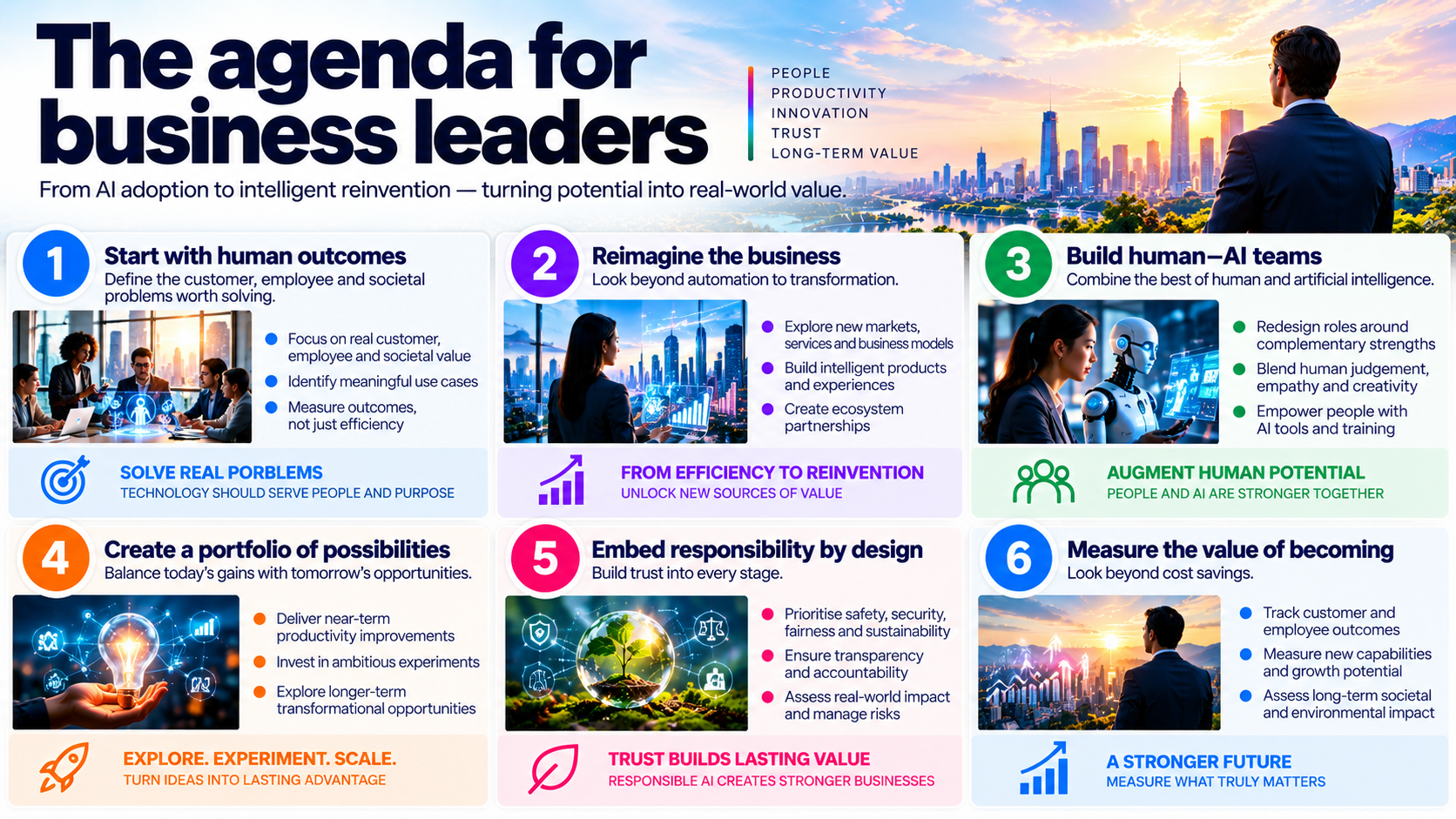
Agenda for business leaders: AI adoption to intelligent reinvention
For executives and boards, the greatest mistake would be to treat AI as another technology programme.
Its significance is more fundamental. AI challenges assumptions about the nature of work, the boundaries of organisations, the economics of expertise and the ways businesses create value.
The opportunity is to move from automation towards augmentation, and ultimately towards reinvention.
Consider three different ambitions. A bank might use AI to reduce the cost of customer service. It might go further, equipping relationship managers with intelligent insights to improve financial advice. Or it might reinvent its business around continuously personalised financial wellbeing, combining human expertise, predictive intelligence and new ecosystem partnerships.
The first improves efficiency. The second enhances performance. The third creates possibilities for entirely new value.
All three matter, but only the third fundamentally changes the organisation’s future potential.
For leaders, this suggests six priorities:
-
Start with human outcomes. Define the customer, employee and societal problems worth solving before selecting technologies.
-
Reimagine the business. Explore new markets, services, business models and ecosystems, rather than simply automating existing processes.
-
Build human–AI teams. Redesign roles around complementary strengths, combining computational intelligence with human judgement, empathy and creativity.
-
Create a portfolio of possibilities. Balance immediate productivity improvements with ambitious experiments and longer-term transformational opportunities.
-
Embed responsibility by design. Make trust, security, fairness, sustainability and accountability part of innovation from the outset.
-
Measure the value of becoming. Look beyond cost savings to customer outcomes, new capabilities, scientific progress, employee development and future growth potential.
These priorities require a different leadership mindset. The question shifts from What can AI do for our existing business?to What could our business become because AI now exists?
It also requires recognising that technological capabilities are not a strategy. Sustainable advantage comes from combining AI with distinctive knowledge, relationships, organisational capabilities, imagination and purposeful leadership.
The next decade: three possible futures
The future of AI is not predetermined. Technology creates possibilities; institutions, markets and human decisions determine which possibilities become reality.
Three broad scenarios illustrate the choices ahead.
1. The fragmented future. Governments compete over technological sovereignty, companies concentrate intelligence within proprietary ecosystems, and public trust deteriorates. AI advances, but its benefits remain uneven and its risks become increasingly difficult to manage.
2. The automated future. AI delivers significant productivity gains, but organisations focus primarily on replacing labour and reducing costs. Economic efficiency improves, while social disruption, inequality and questions of human purpose intensify.
3. The augmented future. Governments establish effective safeguards, businesses redesign work around human–AI collaboration, and education and public investment broaden access. Scientific breakthroughs accelerate, productivity creates new opportunities, and intelligence becomes a catalyst for more inclusive progress.
These scenarios are not forecasts. They are choices expressed as possible futures.
The third is neither inevitable nor utopian. It requires difficult decisions about investment, distribution, institutional reform and the responsibilities of those developing powerful technologies.
But it is an achievable ambition worth pursuing.
The case for optimism
Humanity has never lacked great challenges. Disease, poverty, environmental degradation, inequality and conflict have shaped civilisation for centuries. Our progress has depended on repeatedly finding ways to extend what people can understand, create and achieve.
AI could become one of the most powerful instruments in that continuing journey.
The early evidence is already compelling. AlphaFold’s freely accessible research infrastructure has reached millions of researchers across the world. In drug discovery, a 2025 Nature Medicine study reported promising early clinical results for rentosertib, a compound developed through AI-enabled discovery for idiopathic pulmonary fibrosis, while emphasising the need for further trials.
These are not proofs that AI will solve every major problem. They are demonstrations that the boundaries of possibility are already shifting.
We should be equally clear about what optimism does not mean. It does not mean accepting every claim made by technology companies, overlooking social consequences or assuming that markets will automatically deliver fair outcomes. Nor does responsible governance mean seeking a risk-free future in which every potential harm must be eliminated before progress can begin.
Every major advance involves uncertainty. The challenge is to make intelligent choices about which risks are acceptable, which must be mitigated and which should never be taken.
The greatest danger may be to frame the future as a choice between technological progress and human wellbeing. It should be precisely the opposite.
AI should be developed to extend healthy lives, expand opportunity, restore the environment, improve prosperity and enable more people to participate in shaping their futures. That requires a broader definition of success: not simply more powerful models, higher valuations or greater automation, but measurable progress in the things that matter to people and society.
It also demands more ambitious leadership. Leaders who can see beyond immediate efficiencies, imagine fundamentally better outcomes and have the courage to reinvent organisations around those possibilities.
The power of AI is ultimately the power to unlock human potential. The peril is that we fail to use it wisely, fairly or courageously enough. Not artificial intelligence instead of human intelligence, but the combination of both. Not technology determining our future, but technology expanding our capacity to shape it. Not progress at any cost, but progress made more possible through responsibility.
The next decade will undoubtedly bring disruption, difficult choices and unexpected consequences. It could also bring breakthroughs in health, science, education, sustainability and economic opportunity that transform the lives of billions. We should approach that future neither with blind enthusiasm nor paralysing fear, but with informed optimism, imagination and determination.
Because the greatest promise of artificial intelligence is not what machines might become.
It is what humanity might become with them.
-
Stanford University AI Index Report 2026: Global evidence on AI capabilities, investment, adoption, scientific progress and governance.
-
International AI Safety Report 2026: International scientific assessment of emerging capabilities, misuse, malfunctions and systemic risks.
-
International Energy Agency, Energy and AI: AI infrastructure, electricity demand and opportunities for energy innovation.
-
World Economic Forum, Future of Jobs Report 2025: Global employment transformation, skills, job creation and displacement.
-
International Labour Organization, Generative AI and Jobs: Occupational exposure, labour-market change and inequality.
-
UNESCO Recommendation on the Ethics of Artificial Intelligence: International principles for human rights, fairness, accountability and inclusion.
-
Google DeepMind, AlphaFold: AI applications in protein structure prediction and scientific discovery.
More from the blog