The Reinvention Premium … the most powerful source of value creation in a world of relentless change … financial markets no longer reward companies for what they are, but for what they can become
July 17, 2026

For most of the industrial era, companies created value through improvement. They built better products, stronger brands, larger distribution networks and more efficient operations. They competed by doing what others did, but doing it better, faster or at greater scale.
This old logic created many of the world’s greatest companies of the past: Toyota mastered operational excellence. Walmart perfected supply chain efficiency. Procter & Gamble built category leadership through brand management. General Electric became a symbol of industrial scale and management discipline.
The formula was clear: Build a strong position, optimise performance, defend competitive advantage. But that formula is becoming insufficient.
Today, the defining challenge for CEOs is not simply how to improve an existing business. It is how to ensure that the existing business remains relevant as the world around it changes.
AI is redefining knowledge work and competitive advantage. Biotechnology is reshaping healthcare. Climate technologies are transforming energy and materials. Demographic changes are altering markets and societies. New generations of consumers expect radically different experiences. Entire industries are being redrawn by companies that often began outside traditional sector boundaries.
The speed of change is no longer the only issue. The deeper issue is that the future is arriving faster than many organisations can reinvent themselves. The greatest danger for successful companies is not failure. It is becoming exceptionally good at a business model that belongs to the past.
This is why the greatest value creators of the next decade will not simply be companies that manage change well. They will be companies that master reinvention. Because the stock market increasingly rewards something different: Not only current performance. But future possibility.
The new value equation: from performance to possibility
The financial markets have always valued growth. But increasingly they value something deeper: the belief that a company can create entirely new futures.
Investors are not simply asking “how profitable is this company today?” They are asking “how much larger could this company become tomorrow?”
This distinction explains why some companies experience extraordinary valuation growth while others, despite strong execution, struggle to command a premium. The difference is often not operational performance. It is strategic possibility.
Microsoft provides a powerful example. In 2014, when Satya Nadella became CEO, Microsoft was one of the world’s most successful technology companies. Yet many investors viewed it as a mature software company built around Windows and Office. Its challenge was not that it was failing. Its challenge was that its future appeared smaller than its past.
The company reinvented itself. It moved from a software licensing company to a cloud, data and artificial intelligence platform.Azure, enterprise subscriptions, open-source collaboration and AI partnerships transformed investor expectations. Microsoft’s market cap grew from around $300 billion in 2014 to more than $3 trillion at its peak. The value creation did not come simply from selling more software. It came from investors believing Microsoft had become a fundamentally larger company.
The same pattern can be seen with Nvidia. For much of its history, Nvidia. was viewed as a graphics chip company serving gaming. But leadership anticipated a different future. The company invested in GPU computing, software ecosystems and developer platforms long before artificial intelligence became the defining technology wave. It moved from selling processors to powering the infrastructure of the AI economy. The result was one of the greatest value creation stories in modern corporate history, with market capitalisation increasing from tens of billions to more than $3 trillion.
The lesson is profound: The greatest market value is created when a company changes not just its performance, but the size of the future investors believe it can capture.
The 4 levels of strategic change
One reason many leaders struggle with reinvention is that they confuse different forms of change. Change, innovation, transformation and reinvention are often used interchangeably. They are not the same.
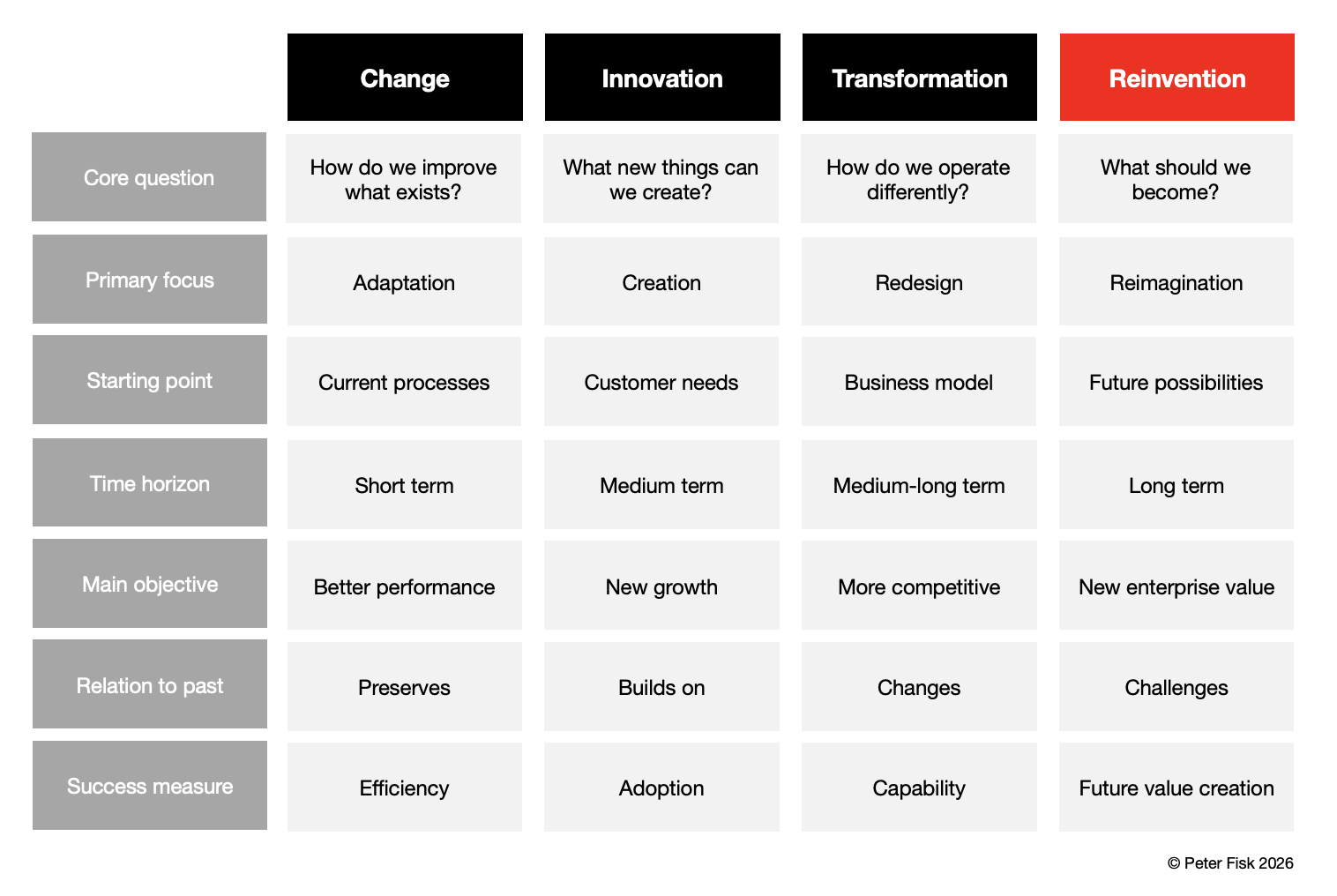
The four concepts, frequently used but poorly defined, represent different levels of ambition and different levels of value creation:
1. Change: Making the current business better
Change is essential. Every company must continuously improve. A manufacturer reducing waste, a bank improving digital services, or a retailer enhancing logistics are all examples of valuable change. But change usually improves the existing formula. It rarely changes the trajectory of the company.
2. Innovation: Creating something new
Innovation creates new products, services and experiences. Apple’s iPhone transformed mobile computing. Dyson reinvented household appliances. Lego expanded beyond physical toys into digital experiences and entertainment. Innovation creates opportunity. But companies can innovate successfully while still remaining vulnerable if their fundamental business model becomes outdated.
3. Transformation: Becoming better at what you do
Transformation goes deeper. It changes how an organisation operates. A traditional retailer becoming omnichannel is transformation. A bank moving from branches to digital platforms is transformation. A manufacturer adopting advanced automation is transformation. Transformation is essential. But it often begins with the assumption “We need to become a better version of ourselves.”
4. Reinvention: Becoming something new
Reinvention starts with a more challenging question: “if we created this company today, knowing what we know about the future, would we build it in the same way?” That question forces leaders to challenge assumptions about identity, industry and opportunity.
Fujifilm understood this better than Kodak. Both companies faced the collapse of photographic film. Kodak saw itself primarily as a photography company. Fujifilm recognised deeper capabilities in chemistry, materials science, precision engineering and imaging. It reinvented itself into healthcare, pharmaceuticals, cosmetics and advanced materials. It did not save the old business. It created a new one.
The difference between transformation and reinvention is therefore fundamental:
- Transformation changes the company you have.
- Reinvention creates the company you need to become.
The Reinvention Premium: financial markets reward future potential
The financial significance of reinvention is that it changes not only what a company does, but how investors perceive the company’s future.
Traditional value creation tends to be incremental. A company improves margins, expands into adjacent markets, gains market share or increases operational efficiency. These improvements matter, but they usually occur within the boundaries of an existing business model.
Consider some of the world’s leading reinvention companies:
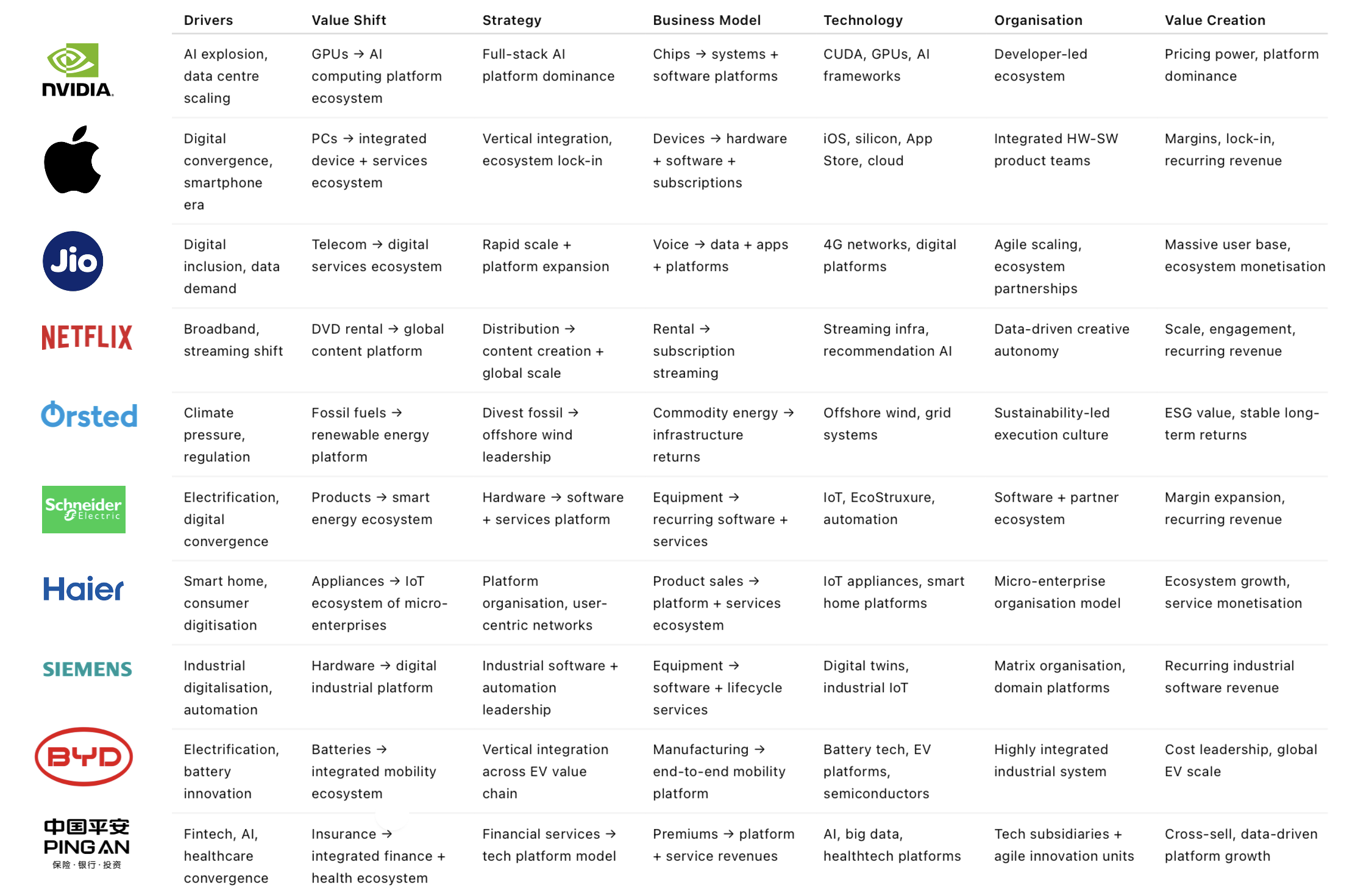
Reinvention is different because it expands those boundaries. It changes the size of the opportunity investors believe is available. A company that becomes more efficient may improve profitability. A company that discovers a new growth engine can change its entire valuation trajectory. This is why market cap often moves most dramatically when investors conclude that a company has become something different.
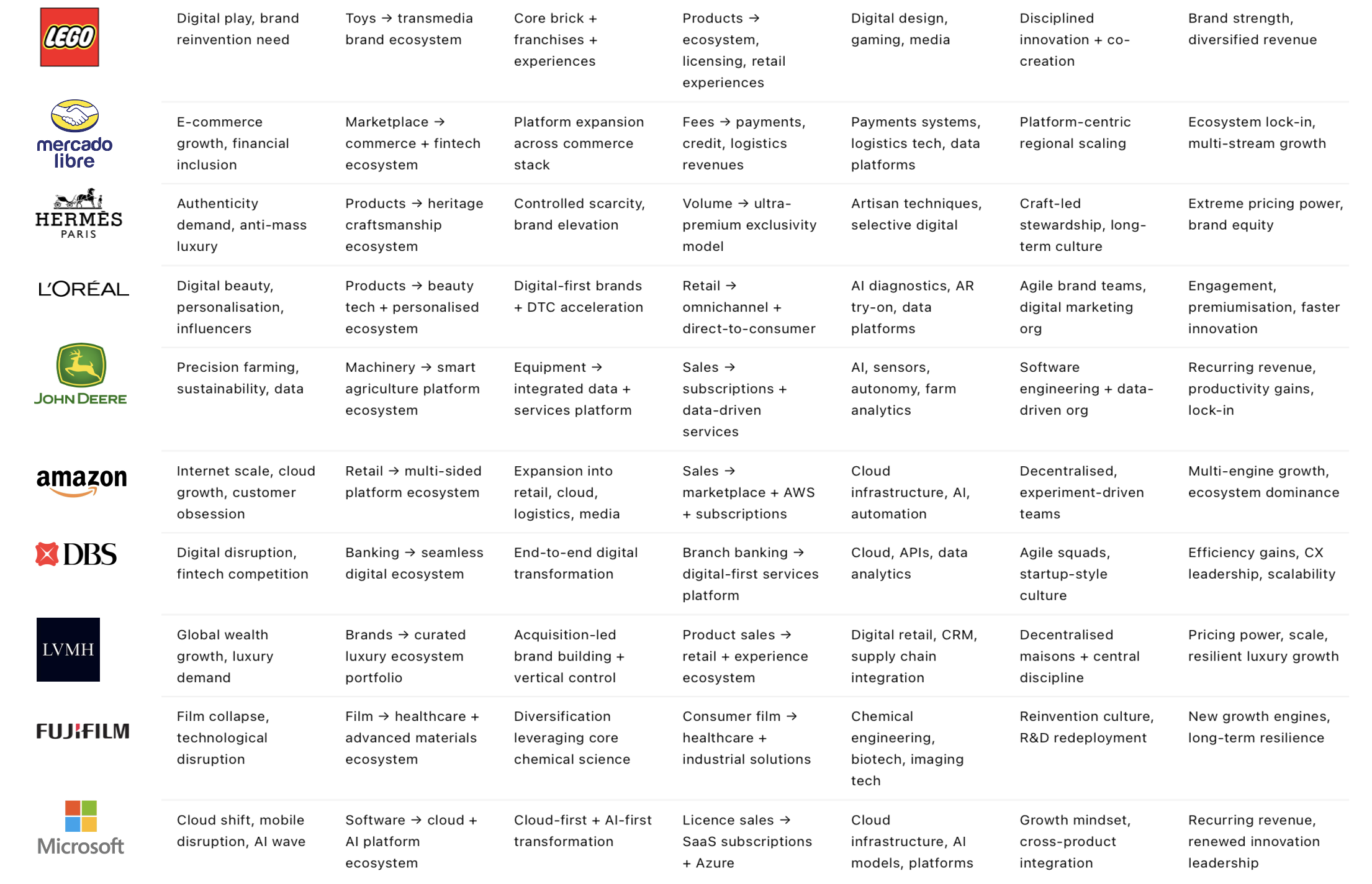
These examples are not simply stories of growth. They are stories of changed investor perception.
The market did not suddenly decide that Microsoft should be valued more highly because it had become a more efficient software company. It changed its view because Microsoft had become central to cloud computing and artificial intelligence. £300 billion to $5 trillion market cap.
Nvidia’s valuation did not explode because it sold more chips. Semiconductor companies have existed for decades. The market revalued Nvidia because it became a critical enabler of an entirely new technology era. $50 billion to $5 trillion.
Amazon’s value creation came from repeatedly creating new businesses around capabilities it had already developed. AWS, advertising and marketplace services were not simple extensions of retail; they changed the economic model of the company. $300 billion to $1 trillion.
This is the essence of what might be called the reinvention premium. The premium exists when investors believe that the future company is significantly larger than the current company.
The 3 CEO blind spots blocking reinvention
If reinvention creates such significant value, why do so many organisations struggle to achieve it?
The answer is that most companies are designed for stability. Their systems, incentives and cultures are built around protecting what made them successful.
That creates three major leadership challenges:
1. CEOs treat transformation as a project instead of building reinvention as a capability
Many organisations approach transformation as a defined initiative: A new strategy is announced. A transformation office is created. Teams are mobilised. New technology is deployed. The assumption is that once the programme is complete, the organisation will have changed. But this logic belongs to a slower era.
When markets evolve continuously, transformation cannot be an occasional event. It must become an organisational capability.
Amazon illustrates this distinction. Amazon’s advantage does not come from a single transformation programme. It comes from a culture designed around continuous reinvention. The company has repeatedly taken capabilities developed in one area and transformed them into new businesses. Its internal technology infrastructure became AWS. Its logistics challenges became a global delivery network. Its marketplace became an advertising platform.
Each reinvention created a new source of value. The company did not ask “How do we optimise ecommerce?” It asked “What capabilities are we building, and what else could they enable?” That is a very different strategic mindset.
2. CEOs optimise today’s business while underinvesting in tomorrow’s possibilities
Every successful company faces a fundamental tension: the activities that create today’s profits are often the activities that consume tomorrow’s opportunities.
Established businesses naturally favour certainty. They allocate resources towards proven markets, existing customers and predictable returns. Reinvention requires investment in possibilities that may not yet have obvious financial returns.
This is why the best companies operate with two simultaneous agendas:
- Performance agenda = deliver today’s results (optimise existing businesses, improve efficiencies, protect existing customers)
- Possibility agenda = create tomorrow’s growth (explore emerging opportunities, build new capabilities, discover future customers)
ASML provides a powerful example. The company invested for decades in extreme ultraviolet lithography technology before the market fully understood its importance. The research was expensive, uncertain and required extraordinary patience. But that investment created a strategic position few competitors can match. The lesson is not simply about technology. It is about time horizons.
Reinvention requires leaders who can see value before the market sees value.
3. CEOs still define their businesses too narrowly, defined by past not potential
The third barrier to reinvention is perhaps the most fundamental: many organisations still define themselves by the industries they were born into.
For much of the twentieth century, this made strategic sense. Industries created clear boundaries. Automotive companies built cars. Banks provided financial services. Insurance companies protected against risk. Telecommunications companies connected people. The boundaries of competition were relatively stable.
Today, those boundaries are dissolving. Technology has made it possible for companies to move across sectors at unprecedented speed. Consumer expectations are increasingly shaped not by competitors within an industry, but by the best experiences they encounter anywhere. A customer does not compare a bank only with another bank; they compare it with Amazon, Apple or any company that delivers simplicity, personalisation and convenience.
The result is that the most valuable companies increasingly compete around human needs rather than industry categories. They ask different questions:
- A traditional automotive company asks “How do we build better vehicles?” A reinvention-oriented company asks“How will people move in the future?”
- A traditional insurer asks “How do we sell more policies?” A reinvention-oriented company asks “How do we help people manage uncertainty throughout their lives?”
- A traditional retailer asks “How do we sell more products?” A reinvention-oriented company asks “How do we become part of customers’ everyday experiences?”
This shift explains why ecosystems have become such a powerful source of competitive advantage.
Examples of reinvention leaders
Ping An, reinventing insurance through the lens of human needs
China’s Ping An provides one of the clearest examples of ecosystem reinvention. The company began as an insurance business. A traditional interpretation of its opportunity would have been to become a more efficient insurer: improve underwriting, expand distribution and sell more policies.
Instead, Ping A questioned the underlying customer problem. Insurance is not fundamentally about policies. It is about helping people manage uncertainty — financial uncertainty, health uncertainty and life uncertainty. That insight led the company beyond insurance into banking, healthcare, technology platforms, artificial intelligence and digital services.
Ping An’s reinvention was not a diversification exercise. It was a redefinition of its purpose. It moved from “we provide insurance products” to “we help people manage the risks and opportunities of life.” That broader ambition opened new markets and allowed the company to create an ecosystem where finance, healthcare and technology reinforce each other.
The lesson for leaders is important: The strongest reinventions often happen when companies move upstream from what they sell to the deeper problem they solve.
Reliance Jio, reinventing an energy company as digital infrastructure
India’s Reliance Industries demonstrates another form of reinvention: using existing strengths to create an entirely new strategic position. For decades, Reliance was primarily known as an energy and industrial company, built around refining, petrochemicals and large-scale infrastructure. But India’s future economic growth was increasingly becoming digital. The company recognised that connectivity would become a foundational infrastructure for the next generation of businesses and consumers.
The creation of Jio transformed Reliance’s role. It moved from building the infrastructure of India’s industrial economy to building the infrastructure of India’s digital economy. Jio was not simply a telecommunications venture. It became the foundation for broader opportunities, a lifestyle super app built on an ecosystem of diverse partners and activities – from retail to banking, entertainment to work, delivery and cloud services.
The strategic insight was that the company’s future would not come from abandoning its capabilities. It would come from redeploying those capabilities into a new context. This is a recurring pattern in successful reinvention. Companies rarely reinvent by starting from nothing. They reinvent by discovering hidden potential in what they already know how to do.
BYD, reinventing the basis of competition
BYD illustrates another important principle: reinvention often requires changing the basis on which an industry competes. The automotive industry spent more than a century competing around mechanical engineering, manufacturing scale and brand heritage. BYD approached mobility differently.
Originally founded as a battery manufacturer, it recognised that the future of transportation would depend on controlling the technologies around electrification: batteries, software, electronics, manufacturing and energy systems. Rather than becoming simply another electric vehicle manufacturer, BYD built an integrated mobility ecosystem.
The company changed the question from “how do we build a better electric car?” to “how do we redefine mobility around the technologies of the future?” That shift helped transform investor perception. BYD became not just a car company, but a strategic player in the global transition towards electrified transportation.
The lesson extends far beyond automotive. When technology changes the foundations of an industry, the winners are often companies that understand the new foundations first.
Fujifilm, the ultimate test of reinvention leadership
Perhaps the most powerful example of reinvention is Fujifilm because it demonstrates the hardest leadership decision of all: the willingness to abandon the identity that created past success. When digital photography emerged, Fujifilm and Kodak faced the same challenge. Both understood the technology shift. Both had strong brands. Both had deep expertise. But they made different strategic choices. Kodak largely viewed itself through the lens of its product category: photography and film.
Fujifilm looked deeper. It recognised that its true capabilities were not film itself, but the underlying science behind film: chemical expertise, materials science, precision manufacturing, imaging technology. Those capabilities had value beyond photography. The company moved into healthcare, pharmaceuticals, cosmetics, advanced materials and digital technologies. Fujifilm did not preserve its original identity. It reinvented it.
This is perhaps the defining characteristic of reinvention leaders: They understand that their greatest asset is not their current business. It is their ability to create the next one.
7 strategic imperatives for Reinvention CEOs
If reinvention is becoming the defining source of competitive advantage, then CEOs need a different leadership agenda. The challenge is not simply to manage change faster. It is to build an organisation capable of continuously becoming something new.
1. Replace transformation programmes with reinvention capability. The goal is not to complete change. The goal is to create an organisation where change is continuous. Reinvention should become part of the operating system.
2. Balance exploitation with exploration. Great companies must run two businesses simultaneously: The business that creates today’s performance. And the business that creates tomorrow’s possibilities. Leaders must protect the core while constantly questioning it.
3. Measure future value creation. Financial performance remains essential, but boards need additional questions: What future markets are we creating? What capabilities are we building? How quickly are we learning? How adaptable is our organisation? This is the logic of the Reinvention Premium.
4. Organise around opportunities, not structures. Traditional organisations are built around functions. Future organisations will increasingly be built around missions, customer needs and emerging opportunities. The question should become “what combination of capabilities can solve this opportunity?” instead of “which department owns this?”
5. Build ecosystems, not just products. The future belongs increasingly to companies that can orchestrate networks of partners, technologies and communities. The ability to connect capabilities may become more valuable than owning every capability.
6. Make reinvention everyone’s responsibility. Innovation cannot sit in a laboratory. Transformation cannot sit in a programme office. Reinvention must become part of every leader’s responsibility. Every business unit must ask“what is the next version of ourselves?”
7. Reinvent before you have to. The greatest reinvention opportunities often appear when companies least feel the need to change. Waiting for decline reduces options. The strongest companies reinvent from a position of strength. They use today’s success as the foundation for tomorrow’s growth.
It’s not what you are, it’s what you can be
For decades, companies measured success through their ability to create and defend advantage. But in a world of accelerating change, where competitive advantage is always temporary, it is the ability to reinvent that matters.
The companies that create the greatest value in the future will not necessarily be those that predict change perfectly. Nobody predicted every detail of cloud computing, artificial intelligence, electric mobility or digital ecosystems. Instead, the winners will be those capable of responding faster, learning faster and reinventing faster.
The final question for every CEO and board is therefore not “how well are we performing today?” it is “are we creating the company that tomorrow’s world will value?”
Because the market no longer rewards companies only for what they are. It rewards them for what they can become.
That is the true meaning of the Reinvention Premium.
More from the blog