Leading for Tomorrow … unlocking human potential in the era of continuous change and endless possibility … here are my 5 leadership principles to thrive in the future
August 5, 2026

Over the last few years, almost every business leader I have worked with has come to recognise a profound reality: the things that created success in the past are unlikely to guarantee success in the future.
The strategies, capabilities, operating models and leadership approaches that helped organisations grow over previous decades were designed for a different era, one characterised by more predictable markets, slower technological cycles and clearer industry boundaries. Today, almost every assumption behind those models is being challenged simultaneously.
AI is reshaping the nature of work and knowledge creation. Geopolitical uncertainty is redefining globalisation. Demographic shifts are transforming societies, customers and workforces. Sustainability is changing the relationship between business, society and the planet. New competitors are emerging from unexpected places, often built on fundamentally different business models.
Microsoft’s latest Work Trend Index captures this moment well. Its research found that 82% of business leaders believe 2025 is a pivotal year to rethink key aspects of their strategy and operations because of AI. The same research points towards the emergence of what Microsoft calls the “Frontier Firm” by which they mean organisations built around human-agent collaboration, where AI does not simply automate tasks but fundamentally reshapes how work gets done.
Building the business of tomorrow
The question facing leaders is therefore no longer whether their organisations need to change. The question is whether they can change fast enough, and whether they can develop the capability to keep changing.
Recent CEO research reflects this growing urgency. PwC’s Global CEO Survey found that 45% of CEOs believe their companies will not be economically viable within ten years if they continue on their current path. The message is clear: reinvention is no longer a choice reserved for companies in crisis; it has become a fundamental leadership responsibility.
Yet there remains a significant gap between recognising the need for reinvention and actually building organisations capable of it.
Most businesses are still designed around the logic of the past. They are structured for efficiency, consistency and control. Their performance systems reward delivery against existing objectives rather than exploration of new opportunities. Their strategies often focus on improving today’s business rather than imagining tomorrow’s.
Even with the arrival of AI, many organisations initially approach it as an enhancement technology: a way to automate existing processes, improve productivity and make current operations more efficient. These benefits are important, but they represent only the first stage of transformation. The bigger opportunity is to rethink how organisations create value, how people work and how entirely new possibilities can be imagined.

Transformation as the new leadership superpower
This is why transformation has become the defining leadership capability of our era.
Not transformation as a one-off programme, but transformation as a continuous organisational capability. And that requires personal transformation from leaders themselves. The leaders who succeed will not simply manage change more effectively; they will become architects of change, creating organisations that are constantly learning, adapting and evolving.
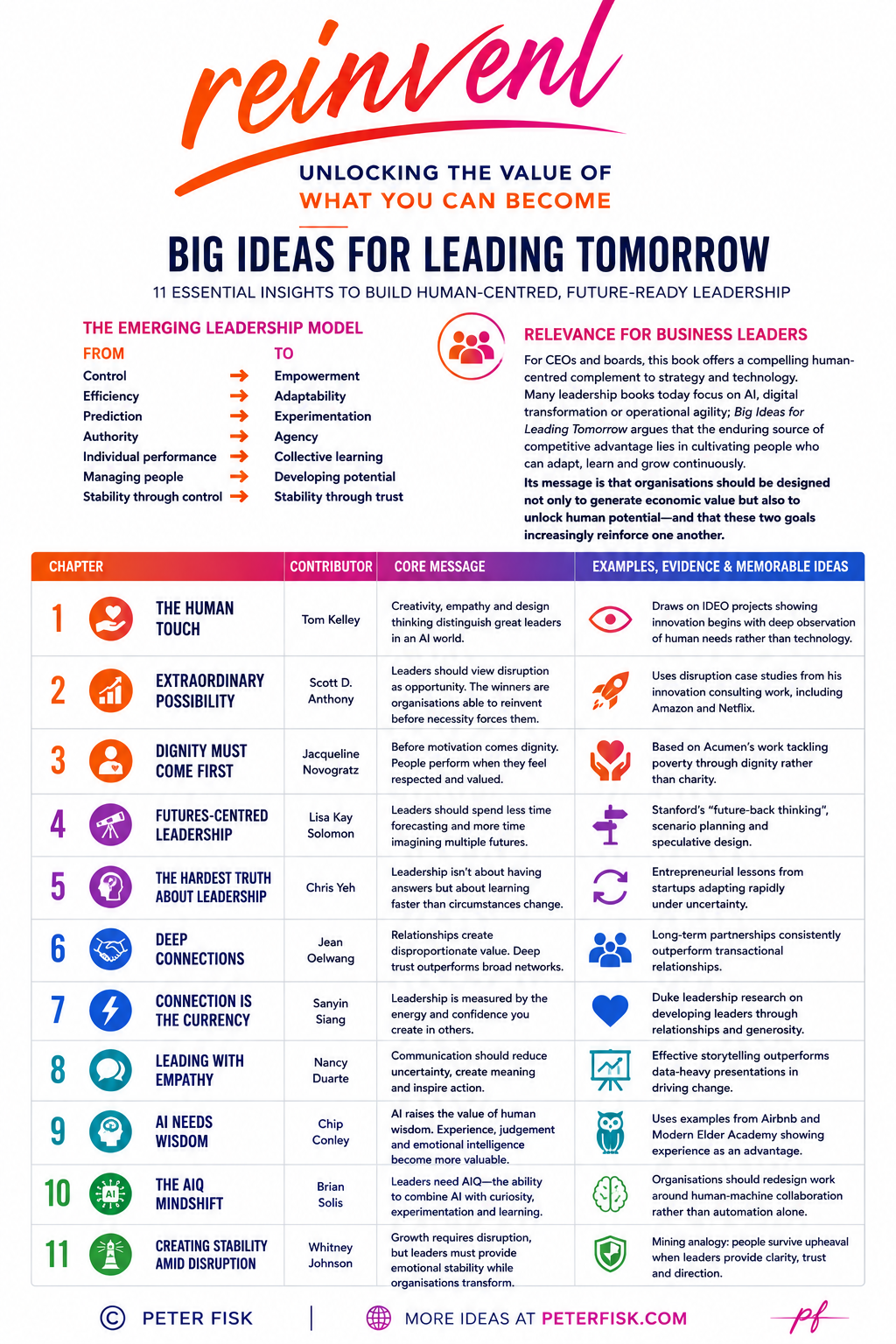
This is the context in which I read the new book Leading for Tomorrow: Unlocking Human Potential in the Era of Continuous Change and Endless Possibility, a great collection of anecdotes and ideas from some of the world’s leading business thinkers, edited by cognitive scientist Scott Barry Kaufman and technology ecosystem catalyst Chris Shipley.
What makes this book particularly interesting is that it brings together voices from different disciplines – strategy, psychology, innovation, behavioural science and technology – to address one of the most important leadership questions of our time: how do we unlock human potential when change has become continuous?
Rather than presenting another formula for leadership success, the contributors collectively challenge many assumptions that have shaped business thinking for decades. Their message is that the organisations of the future will not win simply through technology, scale or efficiency. They will win by becoming more adaptive, more human and more capable of continuous reinvention.
Considering this together, what I see, is some fundamental shifts:
- From efficiency to adaptability … Human adaptability becomes a greater competitive advantage than operational optimisation.
- From control to agency … Empower people to act rather than simply comply.
- From prediction to experimentation … Leaders should run more experiments and make fewer long-term assumptions.
- From expertise to learning … Curiosity, humility and continuous learning matter more than always having the answers.
- From technology-first to human-first … AI amplifies the importance of uniquely human capabilities such as empathy, judgement, creativity and wisdom.
- From performance to flourishing … Organisations achieve better long-term performance when they create environments in which people can realise their potential.
From sustainable advantage to continuous reinvention
One of the strongest themes throughout the book is the changing nature of competitive advantage.
For much of modern business history, leaders sought to build enduring advantages: powerful brands, dominant market positions, proprietary technologies and efficient operating systems that could protect their businesses for many years.
Today, those advantages are increasingly temporary.
Rita McGrath first described her thinking on “transient advantage” to me when I hosted the European Business Forum in Denmark. She describes how organisations can no longer assume yesterday’s success formula will remain effective indefinitely. The most successful companies are those that continually create new sources of value before existing ones decline.
This explains the behaviour of companies such as Amazon, which has repeatedly expanded beyond its original business model, moving from books into marketplace retail, cloud computing, artificial intelligence and multiple new industries. Netflix offers another example: it transformed itself from a DVD rental company into a global streaming and entertainment platform because leaders recognised that the future of the business would not be defined by protecting the past.
The implication for leaders is significant. Strategy can no longer simply be about choosing where to compete and how to win. It must also be about building the organisational capability to continually discover new opportunities.
This is the essence of what I describe as Dynamic Strategy: a future-shaping approach where strategy is continuously shaped by changing environments, emerging possibilities and organisational learning.
The great unfreezing
Scott Anthony develops this argument further by suggesting that we are living through what he describes as a “great unfreezing”, a period in which long-established assumptions about industries, organisations and leadership are rapidly dissolving. The challenge for leaders is not simply to respond to disruption, but to recognise the extraordinary possibilities that disruption creates.
I actually once hosted a boxing match with Scott (against Howard Yu from IMD, with 5 rounds each debating the future of strategy thinking – both guys boxed smart, as you’d expect for great thinkers, but Scott won!).
He argues that organisations rarely fail because they cannot see change coming; they fail because they remain too committed to the logic that made them successful in the first place. Great leaders therefore cultivate two complementary capabilities: the wisdom to see opportunities that others overlook, and the courage to let go of assumptions, products or business models that have outlived their usefulness.
Reinvention is as much about deciding what to stop doing as it is about imagining what comes next. It requires leaders to become comfortable with ambiguity, to experiment before certainty exists, and to create the future while today’s business is still performing well.
That idea aligns strongly with his long-standing work on disruptive innovation: transformation is most successful when it begins from a position of strength rather than as a last response to decline.
Human advantage in a world of AI
One of the most powerful insights in Leading for Tomorrow is that, despite its focus on technology and disruption, the book is fundamentally about people.
The book argues that the defining advantage of the future will not be technological capability alone, because technology will become increasingly accessible. Instead, advantage will come from how effectively organisations unlock uniquely human capabilities.
AI can process enormous quantities of information. It can recognise patterns, generate content and automate many forms of analysis. But human beings remain essential for imagination, judgement, empathy, ethical reasoning and the ability to create meaning.
The challenge for leaders is therefore not simply to deploy AI, but to redesign organisations around the combination of human and machine intelligence. This requires a different view of leadership. The traditional leadership question has often been: how do we get more performance from people? The emerging leadership question is: how do we create the conditions in which people can contribute more of their potential?
This is the idea of “agency” … People perform at their best when they feel ownership, purpose and the ability to influence outcomes. Organisations that create agency will be better positioned to adapt than those that simply demand compliance.
Innovation starts with people
I first met Tom Kelley in Istanbul when design thinking was a new idea, and IDEO was becoming its temple. His contribution reinforces an important lesson: innovation begins with empathy.
At a time when many organisations are fascinated by the possibilities of AI, there is a danger that technology becomes the starting point rather than the customer or human need.
IDEO’s approach has always been based on observing people closely, understanding their frustrations and discovering opportunities that others overlook. The redesign of healthcare experiences, consumer products and everyday services often begins not with advanced technology but with simple observation and curiosity.
The lesson for leaders is that innovation is not primarily a technology challenge. It is a human challenge. The organisations that understand people most deeply will be best positioned to create meaningful solutions.
Learning organisations are winning organisations
Perhaps the biggest shift in leadership thinking is moving from organisations that know to organisations that learn.
In a world of rapid change, expertise remains valuable, but it has a shorter lifespan. The capabilities that create success today may become obsolete tomorrow.
When I interviewed Amy Edmondson at the Thinkers50 Summit in London, she focused on her research into psychological safety which demonstrates that organisations learn fastest when people feel safe to question assumptions, challenge decisions and admit mistakes. Based on Google’s Project Aristotle, sheshowed that high-performing teams are not those that avoid failure; they are those that learn most effectively from experience.
John Hagel extends this thinking by arguing that the future belongs to organisations built around scalable learning rather than scalable efficiency. For much of the industrial era, companies competed by making processes more efficient. Increasingly, they will compete by improving their ability to learn.
This requires a fundamental cultural shift. Experimentation must become normal. Curiosity must be rewarded. Failure must become a source of insight rather than something to hide.
The more human organisation
Another powerful theme in the book is that investing in people is not simply a cultural choice. It is a strategic advantage.
Jacqueline Novogratz argues that dignity is central to human performance. People contribute most when they feel respected, trusted and valued.
Zeynep Ton‘s research challenges the belief that employee investment is merely a cost. Her studies of companies such as Costco, QuikTrip and Mercadona demonstrate that organisations which invest in frontline employees often achieve stronger financial results because engaged people create better customer experiences.
Jean Oelwang and Sanyin Siang similarly emphasise the importance of connection and relationships. In an increasingly digital world, trust becomes even more valuable. The quality of relationships inside organisations will increasingly determine their ability to collaborate, innovate and adapt.
The future organisation is therefore not less human because of technology. It needs to become more human because of technology.

5 leadership principles for an age of continuous reinvention
Drawing together the insights from Leading for Tomorrow with my own work on reinvention, future strategy and long-term value creation, I believe five principles will define successful leadership over the coming decade.
1. Lead from the future back
- Too many organisations are still designed around managing today’s performance. Future leaders must spend more time imagining tomorrow’s possibilities.
- This means developing a stronger future orientation: exploring emerging trends, challenging assumptions and creating strategies that are designed for multiple possible futures rather than a single predicted outcome.
- The best leaders do not simply respond to the future when it arrives. They actively participate in shaping it
2. Build living organisations
- The organisations of the future must behave more like living systems. They need the ability to sense change, learn continuously and adapt naturally.
- This means moving beyond rigid structures and annual planning cycles towards more dynamic approaches where strategy evolves, teams collaborate across boundaries and innovation becomes part of everyday work.
- Adaptability will become a more valuable capability than efficiency alone.
3. Unlock human potential
- The greatest opportunity from AI is not replacing people. It is enabling people to achieve more.
- Leaders must focus on developing curiosity, creativity, judgement and imagination—the capabilities that differentiate humans from machines.
- The organisations that unlock human potential will create stronger innovation, greater engagement and deeper customer value.
4. Learn faster then change
- The speed of external change will increasingly exceed the ability of traditional organisations to respond. The answer is not better prediction. It is faster learning.
- Leaders must create environments where experimentation is encouraged, diverse perspectives are welcomed and knowledge flows freely across the organisation.
- The ability to learn faster than competitors may become the ultimate source of competitive advantage.
5. Make reinvention a habit
- Transformation can no longer be treated as something that happens every few years when circumstances demand it.
- The most successful organisations will make reinvention part of their everyday operating rhythm. They will continually question their business models, rethink customer experiences, develop new capabilities and challenge their own assumptions.
- The question every leader should continually ask is not simply “How can we improve what we do today?” but “What should we reinvent before someone else does?”
The future is a leadership challenge
What makes Leading for Tomorrow such a valuable contribution is that it recognises a truth that is easy to overlook.
The future of business is not only a technology challenge. It is fundamentally a leadership challenge.
AI, digital platforms and new technologies will reshape industries, but their impact will ultimately depend on whether leaders create organisations capable of learning, adapting and imagining new possibilities.
The winners of the next decade will not necessarily be those with the most resources or the most advanced technologies. They will be those that combine intelligent technology with enlightened leadership, creating organisations that are both more adaptive and more human.
The future belongs to leaders who understand that reinvention is no longer something organisations do. It is something they become.
More from the blog