The Thrive Manifesto … How future-ready leaders turn pressure into possibility, performance into flourishing … and change into a force for human and business growth
May 10, 2026
There is a moment in every great athlete’s journey when performance becomes something deeper than winning.
After years of relentless training, sacrifice, setbacks and recovery, they arrive at a different understanding of excellence. Peak performance is no longer about brute force or endless exertion. It becomes more holistic. More human. The greatest athletes learn that sustainable greatness comes from the integration of mind, body, emotion, purpose and resilience.
The pursuit shifts from simply pushing harder to becoming better.
The same transformation is now happening in business leadership.
For decades, leadership was largely defined by endurance, control and execution. Success meant working longer, driving harder, scaling faster. The corporate hero was the tireless executive who could absorb pressure without emotion and deliver results regardless of the personal or organisational cost.
That model produced extraordinary companies and immense economic growth. But it also created exhausted leaders, burned-out teams and cultures increasingly disconnected from meaning, humanity and long-term wellbeing.
Today, the context has changed dramatically.
AI is reshaping work. Markets are being reinvented overnight. Employees seek meaning as much as money. Younger generations expect businesses to contribute positively to society. Anxiety, uncertainty and complexity have become permanent features of organisational life.
The challenge for leaders is no longer simply how to perform. It is how to thrive whilst enabling others to thrive too.
This is not about lowering standards or becoming less ambitious. In many ways, the opposite is true. The leaders and organisations that will shape the future are those capable of sustaining extraordinary performance whilst remaining adaptive, energised, purposeful and deeply human.
In elite sport, the pursuit of greatness is not achieved through constant exhaustion. The best athletes understand rhythm — effort and recovery, intensity and reflection, discipline and renewal. They learn to manage emotional states, regulate pressure and maintain clarity amidst chaos.
Modern leadership increasingly demands the same sophistication.
The physiologist and endurance expert Alex Hutchinson has written extensively about the limits of human performance and the hidden role of the mind in extending endurance. His research demonstrates that peak performance is rarely just physical. It is shaped by belief, perception, emotional resilience and the stories we tell ourselves about our capabilities.
Business leadership is no different.
The future belongs to leaders who can expand possibility rather than transmit fear. Leaders who create trust under pressure. Leaders who combine ambition with empathy. Leaders who sustain energy rather than glorify burnout.
This is where “positive psychology” becomes deeply relevant.
The psychologist Martin Seligman spent decades challenging the assumption that psychology should focus only on dysfunction and weakness. Instead, he explored what allows people to flourish — optimism, meaning, resilience, strengths, hope and positive relationships.
His work transformed leadership thinking. Flourishing, he argued, is not naïve happiness. It is the ability to live with purpose, engagement, accomplishment and connection even amidst adversity.
In parallel, psychologist Susan David introduced the concept of “emotional agility” — the ability to engage honestly with emotions without becoming trapped by them. Her work is especially important in leadership because modern organisations often reward emotional suppression rather than emotional intelligence.
Yet emotions are not distractions from leadership. They are signals about what matters.
Leaders who ignore fear, uncertainty or exhaustion often make poorer decisions. Those who acknowledge emotions honestly — whilst responding with clarity and intention — create stronger cultures and greater resilience.
Perhaps few business leaders embody this shift more clearly than Satya Nadella.
When Nadella became CEO of Microsoft in 2014, the company was financially powerful but culturally stagnant. Internal competition, defensive thinking and institutional arrogance had weakened innovation. Nadella did not begin transformation primarily with technology. He began with mindset.
Influenced by psychologist Carol Dweck’s idea of the “growth mindset”, he encouraged the organisation to move from a culture of “know-it-alls” to “learn-it-alls”. Empathy became a strategic capability. Curiosity became more important than hierarchy. Collaboration replaced internal silos.
The results were extraordinary. Microsoft reinvented itself culturally and commercially, becoming once again one of the world’s most valuable and innovative companies.
Nadella demonstrated something profound: human-centred leadership is not separate from high performance. It is increasingly the foundation of it.
This insight sits at the heart of The Thrive Manifesto — ten commitments for leaders determined not merely to survive relentless change, but to flourish through it and help others do the same.
Because ultimately, leadership is not unlike elite sport.
The greatest athletes are never finished products. Even at their peak, they continue stretching limits, refining technique, strengthening mindset and redefining what is possible. They embrace discomfort because growth lives on the other side of it.
The best leaders do the same.
They remain curious. They adapt continuously. They recover intelligently. They develop emotional resilience. They sustain belief amidst uncertainty. And they inspire others to become more capable than they imagined possible.
In an age of volatility and transformation, thriving is not accidental. It is intentional.
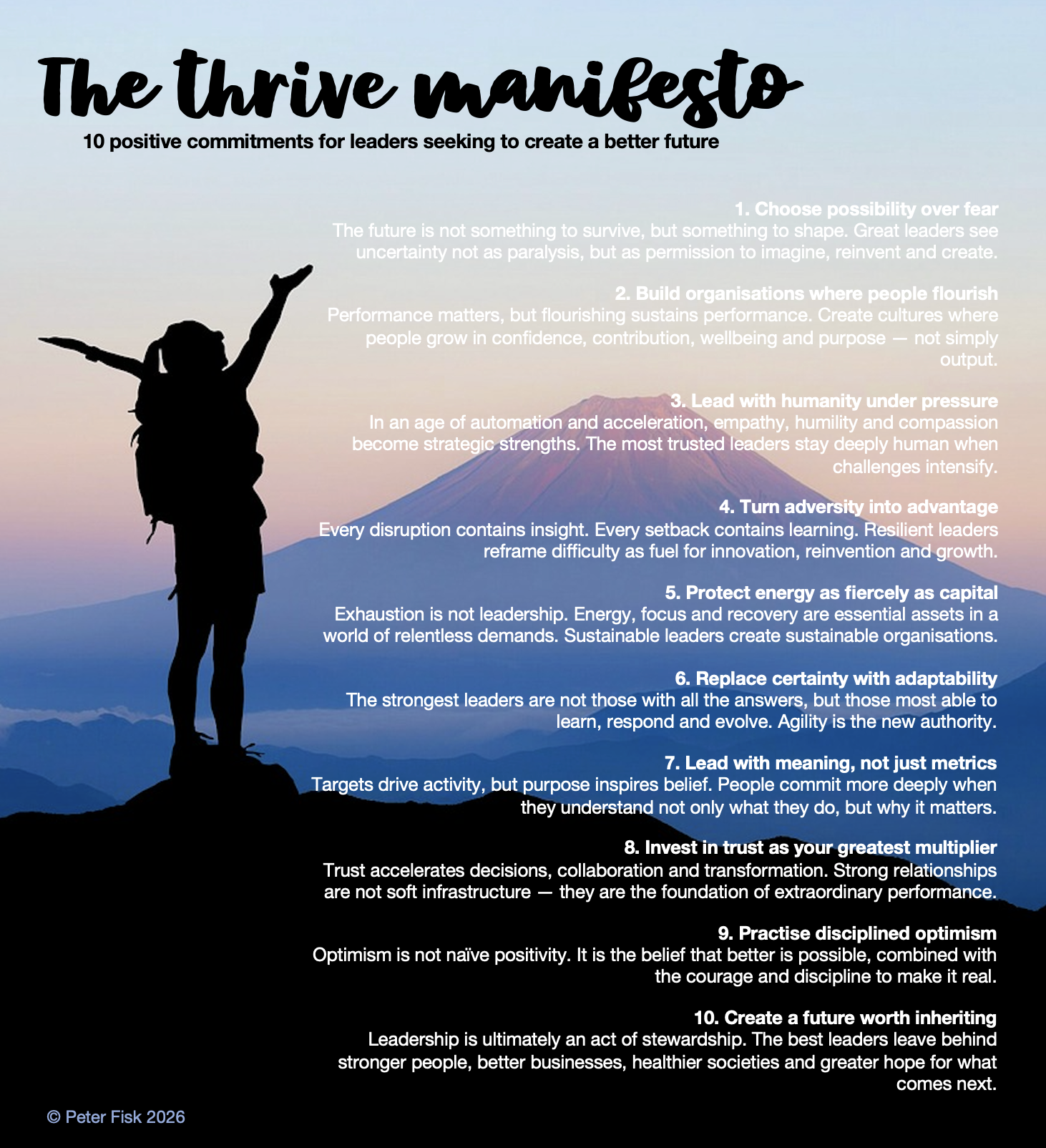
The Thrive Manifesto
1. Choose possibility over fear
The future is not something to survive, but something to shape. Great leaders see uncertainty not as paralysis, but as permission to imagine, reinvent and create.
Elite athletes understand that growth begins at the edge of discomfort. Improvement rarely happens inside familiar routines. It emerges through stretching limits — physically, mentally and emotionally.
Leadership works the same way.
Fear narrows perspective. It encourages defensive behaviour and incremental thinking. Possibility expands perspective. It encourages experimentation, reinvention and ambition.
Martin Seligman’s research into learned optimism showed that people who believe their actions can influence outcomes are more resilient, adaptive and persistent under pressure. Optimism is not wishful thinking. It is a strategic orientation towards possibility.
The leaders shaping the future are those willing to move before certainty arrives.
2. Build organisations where people flourish
Performance matters, but flourishing sustains performance. Create cultures where people grow in confidence, contribution, wellbeing and purpose — not simply output.
High-performance athletes do not train by destroying themselves every day. Their coaches carefully balance intensity with recovery, growth with restoration. The goal is sustainable excellence.
Yet many organisations still operate as though exhaustion equals commitment.
Flourishing cultures recognise that human energy is not infinite. People perform best when they feel psychologically safe, connected, valued and purposeful.
Seligman’s PERMA model — Positive emotion, Engagement, Relationships, Meaning and Achievement — provides a powerful framework for understanding human flourishing. Remarkably, these same qualities also underpin high-performing teams and organisations.
The best businesses increasingly understand that wellbeing and performance are not competing priorities. They are mutually reinforcing.
3. Lead with humanity under pressure
In an age of automation and acceleration, empathy, humility and compassion become strategic strengths. The most trusted leaders stay deeply human when challenges intensify.
Susan David argues that emotional agility begins by recognising emotions honestly rather than suppressing them. Difficult emotions are not weaknesses. They are information.
This is especially true in leadership.
During uncertainty, employees observe leaders intensely. They look for emotional steadiness, authenticity and trustworthiness. Leaders who communicate transparently create calm amidst chaos.
Satya Nadella often speaks about empathy not merely as a moral virtue, but as a source of innovation. Understanding human needs more deeply allows organisations to create better products, better cultures and better decisions.
In a world increasingly shaped by machines, humanity becomes a competitive advantage.
4. Turn adversity into advantage
Every disruption contains insight. Every setback contains learning. Resilient leaders reframe difficulty as fuel for innovation, reinvention and growth.
Elite athletes rarely develop resilience through victory alone. They grow through injury, defeat, setbacks and moments of doubt.
The same is true for organisations.
Alex Hutchinson’s exploration of endurance highlights how perceived limits are often psychological as much as physical. Human beings are capable of far more than they initially believe possible.
Great leaders cultivate this mindset inside organisations. They create cultures where setbacks become learning rather than shame.
Resilience is not passive endurance. It is intelligent adaptation.
5. Protect energy as fiercely as capital
Exhaustion is not leadership. Energy, focus and recovery are essential assets in a world of relentless demands. Sustainable leaders create sustainable organisations.
Many elite athletes obsess over recovery — sleep, nutrition, mental reset, reflection and restoration. They understand that peak performance requires deliberate renewal.
Yet business culture still often glorifies depletion.
The consequence is predictable: diminished creativity, poorer judgement and emotional fatigue.
Thriving leaders understand that energy management is strategic. Recovery is not separate from execution. It is part of execution.
The organisations that sustain innovation over decades will be those capable of sustaining human vitality too.
6. Replace certainty with adaptability
The strongest leaders are not those with all the answers, but those most able to learn, respond and evolve. Agility is the new authority.
In modern sport, champions constantly adapt — training methods evolve, strategies shift, technologies improve. Standing still means decline.
Leadership now requires similar adaptability.
Satya Nadella transformed Microsoft partly by embedding learning into culture. Curiosity became more valuable than certainty. Experimentation became more important than protecting ego.
Susan David’s concept of emotional agility also reinforces adaptability. Leaders who remain psychologically flexible respond more intelligently to complexity and change.
The future rewards leaders who evolve faster than circumstances around them.
7. Lead with meaning, not just metrics
Targets drive activity, but purpose inspires belief. People commit more deeply when they understand not only what they do, but why it matters.
Athletes pursuing greatness are rarely motivated purely by medals or rankings. They are driven by mastery, identity, purpose and contribution.
Business leadership is no different.
People want their work to matter. They want to feel connected to something larger than operational targets.
Purpose creates resilience because it provides emotional fuel during difficult periods.
Seligman’s work consistently demonstrated that meaning is central to flourishing. Achievement alone does not create fulfilment. Contribution does.
The most inspiring organisations therefore connect commercial ambition with human impact.
8. Invest in trust as your greatest multiplier
Trust accelerates decisions, collaboration and transformation. Strong relationships are not soft infrastructure — they are the foundation of extraordinary performance.
No athlete succeeds entirely alone. Coaches, teammates, medical staff and support systems all rely on deep trust.
Organisations are the same.
High-trust cultures move faster because people communicate openly, challenge constructively and collaborate more effectively.
Trust cannot be manufactured through slogans. It is built through consistency, integrity and empathy.
Nadella’s transformation of Microsoft succeeded partly because he rebuilt trust internally — replacing fear and rivalry with openness and collaboration.
Trust reduces friction. And in complex environments, reduced friction becomes a major competitive advantage.
9. Practise disciplined optimism
Optimism is not naïve positivity. It is the belief that better is possible, combined with the courage and discipline to make it real.
Elite athletes often maintain extraordinary belief even when evidence temporarily suggests otherwise. They trust the process. They persist through plateaus. They understand that progress is rarely linear.
Disciplined optimism operates the same way in leadership.
Martin Seligman’s research showed that optimistic people tend to recover faster from setbacks because they interpret adversity as temporary and solvable rather than permanent and defining.
This mindset becomes culturally contagious.
Leaders who communicate grounded optimism create confidence, resilience and momentum. They inspire people to continue moving forward despite uncertainty.
The future is created first through belief, then through disciplined action.
10. Create a future worth inheriting
Leadership is ultimately an act of stewardship. The best leaders leave behind stronger people, better businesses, healthier societies and greater hope for what comes next.
The greatest athletes eventually realise their legacy extends beyond medals or records. It lies in how they inspired others, elevated standards and expanded belief about what humans can achieve.
Leadership should aspire to the same standard.
Businesses today shape society profoundly — through technology, culture, employment, sustainability and innovation. Leaders therefore carry immense responsibility.
Thriving leaders think beyond short-term extraction. They build organisations capable of enduring contribution.
They ask not simply, “How do we grow?” but “What kind of future are we creating?”
Because ultimately, leadership is not about preserving the status quo. It is about expanding human possibility.
Thriving as the new advantage
The next era of business will not belong to the most ruthless organisations.
It will belong to the most adaptive, energised, purposeful and human ones.
The leaders who succeed will resemble elite athletes at the peak of their powers — disciplined yet curious, resilient yet reflective, ambitious yet grounded. Always learning. Always stretching. Always pursuing better.
They will understand that peak performance is not achieved through fear or exhaustion alone, but through belief, meaning, emotional resilience and human connection.
And perhaps that is the greatest leadership shift of all.
The future will not be shaped merely by smarter technologies or faster systems.
It will be shaped by leaders capable of helping human beings thrive amidst relentless change.
More from the blog