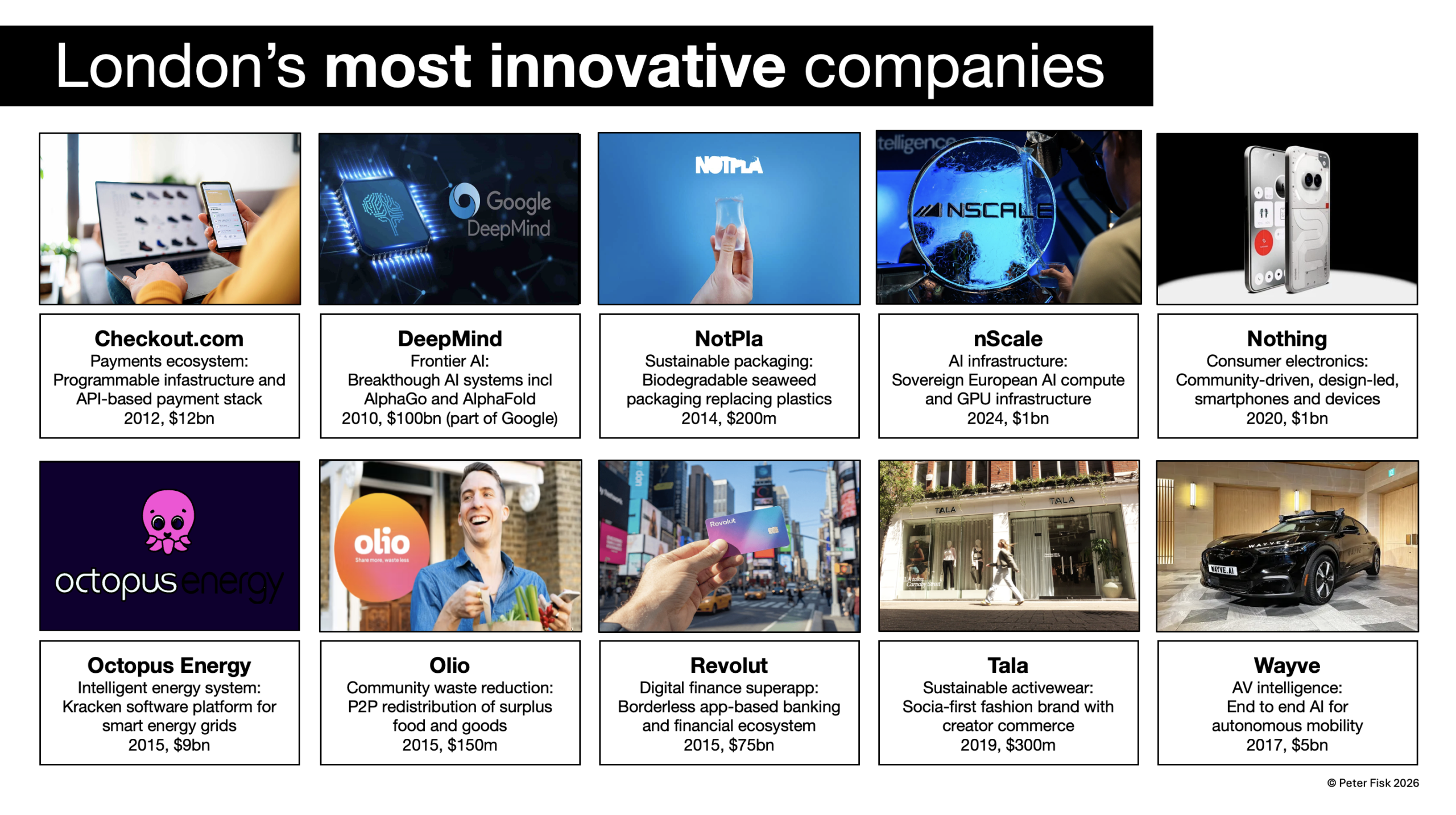
Innovative London … Checkout to Deepmind, Notpla and Nscale, Nothing to Octopus, Olio and Revolut, Tala to Wayve … 10 London-based innovators quietly rebuilding the operating system of the modern economy
May 14, 2026

There are moments when a city stops behaving like a place and starts behaving like a platform. London is in one of those moments.
For most of the past two centuries, its identity was relatively stable: global finance in the Square Mile, legal gravity around it, creative industries layered across Soho, media in West London, and a steady export of ideas, capital and institutions. But beneath that familiar surface, something more structural has been forming.
A different kind of economy is emerging in London. Not defined by sectors, but by systems. Not defined by firms, but by infrastructure. Not even defined by products, but by how the world works.
Finance is becoming software. Energy is becoming data. Logistics is becoming intelligence. Consumption is becoming culture-as-platform. And materials themselves are beginning to behave like biology.
This is not a story of “start-ups” in the traditional sense. It is a story of early operating systems for industries that have not yet fully realised they are being rebuilt. Ten companies, in particular, illuminate this shift. They are not the only ones, nor even necessarily the biggest. But they are among the clearest signals of where London is heading.
Today I’m back home in London, helping some of Europe’s innovation leaders to explore my city, although to be honest I spend more time in other cities around the world. So it’s refreshing to focus on my home town, and celebrate what’s thriving right now. Perhaps by taking a slightly outside view, I can take stock of what is really happening in the British capital.
Before looking at the most innovative companies individually, it is worth stepping back to see the pattern they form.

What’s actually changing in London
The first change is structural. London is no longer primarily exporting financial services or creative content. It is exporting systems logic.
Three shifts sit underneath this.
1. From institutions to infrastructure
For centuries, London’s power came from institutions: banks, insurers, law firms, exchanges, and regulators. These were stable, hierarchical systems built for predictability.
The new generation of companies does something different. They do not replicate institutions — they replace their function with software.
Money is no longer managed by banks, but by platforms.
Payments are no longer processed by intermediaries, but by APIs.
Energy is no longer distributed by utilities, but orchestrated by software layers.
Identity is no longer defined by brands, but by communities.
The institution is dissolving into infrastructure.
2. From products to systems
The second shift is from discrete products to continuous systems.
A product is something you buy. A system is something you live inside.
A bank account becomes a financial ecosystem.
A delivery company becomes a real-time logistics network.
A fashion brand becomes a social identity engine.
A materials company becomes part of a circular resource loop.
The implication is profound: value is no longer captured at the point of sale, but through ongoing participation.
3. From sectors to convergence
The third shift is convergence.
The boundaries between industries are breaking down:
Finance merges with software and identity.
Energy merges with AI and optimisation.
Logistics merges with robotics and autonomy.
Fashion merges with culture, media, and platforms.
Materials merge with biology and sustainability science.
In this environment, companies are no longer “in” industries. They are recombining them.
It is within this context that the following ten companies matter. Not because they are the biggest or safest bets, but because each represents a different piece of the emerging operating system of the future economy.
They are listed alphabetically — but together they form something far more coherent: a map of how London is being rebuilt.
Checkout
Checkout.com is one of the clearest examples of London’s invisible power: infrastructure that the world depends on but rarely sees.
Founded by Guillaume Pousaz in 2012, the company began with a simple idea — global commerce was still running on fragmented, inefficient payment systems that did not reflect the speed or scale of the internet economy.
What emerged is a global payments infrastructure company that sits beneath some of the world’s largest digital platforms.
Its role is not consumer-facing. It does not try to “own the user experience”. Instead, it optimises what happens before the experience even begins: transaction routing, fraud detection, settlement efficiency, and conversion optimisation.
In many ways, Checkout.com represents a shift in how value is created in modern economies:
- from visible interfaces → to invisible optimisation layers
- from products → to infrastructure APIs
- from banks → to programmable payment systems
Strategically, the company is part of a broader reconfiguration of global finance: money becoming real-time, embedded, and computational. If Revolut represents the user-facing future of money, Checkout.com represents its underlying architecture.
DeepMind
DeepMind occupies a different category altogether. It is not a company in the conventional sense, but a scientific engine that has reshaped the trajectory of artificial intelligence globally.
Founded in London in 2010 by Demis Hassabis, Shane Legg and Mustafa Suleyman, DeepMind was built on a belief that intelligence itself could be modelled, learned, and scaled.
Its early breakthrough, AlphaGo, demonstrated that machines could master domains previously thought to require uniquely human intuition. Its later breakthrough, AlphaFold, solved one of biology’s most complex problems: predicting protein structure.
This achievement alone has had implications across medicine, drug discovery, and life sciences that are still unfolding.
DeepMind matters for three reasons:
- it established London as a credible centre for frontier AI research
- it created a global talent diaspora feeding the UK’s wider AI ecosystem
- it demonstrated that AI is not just computational — it is scientific infrastructure
Today, DeepMind sits inside Google, but its influence extends far beyond corporate boundaries. It is part of the intellectual foundation of the AI era.
Notpla
Notpla represents one of the most radical shifts in this entire group: the rethinking of materials themselves.
Founded by Rodrigo Garcia Gonzalez and Pierre Paslier, Notpla develops packaging made from seaweed and other natural materials designed to biodegrade naturally or even be consumed.
At first glance, this appears to be a sustainability story. But at a deeper level, it is something more fundamental.
Notpla is part of a transition from industrial materials to biological materials — from plastic as a default, to nature as a design system.
Its significance lies in three dimensions:
- materials that disappear rather than accumulate
- packaging that integrates with biological cycles
- industrial design inspired by ecological systems
This is not incremental innovation. It is a reframing of what “materials” even are.
If scaled, companies like Notpla will not just replace plastic. They will redefine the material foundation of consumption itself.
nScale
nScale sits at the centre of one of the most critical bottlenecks in the AI era: compute.
While much attention is given to AI models and applications, the real constraint is infrastructure — GPUs, data centres, energy, and sovereign computing capacity.
nScale is building large-scale AI infrastructure designed to address this gap in Europe. Its ambition is not simply to host workloads, but to provide the backbone for AI systems at national and continental scale.
This places it in a strategically important position:
- AI demand is growing exponentially
- compute capacity is geographically concentrated in the US
- Europe is underpowered in AI infrastructure
nScale’s opportunity lies in becoming part of the solution to that imbalance. In effect, it is building what could be described as the industrial grid of artificial intelligence.
Nothing
Nothing is a very different kind of innovation story. It is not about infrastructure or systems, but about perception.
Founded by Carl Pei after his work at OnePlus, Nothing set out to challenge a stagnating consumer electronics industry where differentiation had largely disappeared.
Its strategy is not to compete on specification, but on design language and cultural identity. Transparent hardware, distinctive aesthetics, and a strong emphasis on community engagement position Nothing as a brand that sits at the intersection of technology and fashion.
Its significance lies in a broader shift:
- hardware is becoming expressive rather than invisible
- consumer electronics are becoming identity objects
- design is becoming a competitive moat again
Nothing reflects a world where technology is no longer neutral. It is cultural.
Octopus Energy
Octopus Energy represents one of the most important reinventions of a traditional industry anywhere in Europe.
Founded by Greg Jackson, it began with a simple premise: energy markets were structurally inefficient, customer-hostile, and technologically outdated.
Its breakthrough was Kraken, a software platform that manages energy retail operations, grid balancing, and customer interactions at scale. This transforms the company from a utility into something closer to a software platform that happens to operate in energy.
Octopus is now active in multiple countries and increasingly licenses its technology globally.
Its significance lies in a deeper shift:
- utilities becoming software companies
- energy systems becoming real-time networks
- grids becoming intelligent and dynamic
In this sense, Octopus is not just an energy supplier. It is a prototype for the future of distributed energy systems.
Olio
Olio is one of the most interesting examples of behavioural innovation in this group.
Founded by Tessa Clarke and Saasha Celestial-One, it connects people and businesses to share surplus food and household items locally.
Unlike traditional logistics or supply chain companies, Olio does not optimise distribution efficiency. It optimises human behaviour.
Its core insight is simple but powerful: waste is often a coordination failure, not a production failure. Olio transforms individuals into nodes within a circular sharing network, using trust, proximity, and social engagement as its core mechanisms.
Its importance lies in what it represents:
- redistribution as infrastructure
- community as supply chain
- behaviour as system design
Olio is less a marketplace and more a social operating layer for reducing waste.
Revolut
Revolut is one of the most visible symbols of London’s new financial system.
Founded by Nikolay Storonsky and Vlad Yatsenko in 2015, it began as a solution to expensive foreign exchange fees but rapidly expanded into a full financial ecosystem.
Today it includes banking, payments, trading, crypto, business accounts, and increasingly lending and wealth management. Its strategic direction is clear: to become a global financial super-app.
Revolut represents a shift from banking as an institution to banking as a platform:
- modular financial services
- embedded consumer experiences
- global, borderless money flows
It is not just a fintech company. It is an attempt to redefine how individuals interact with money at a global scale.
Tala
Tala reflects the next generation of digitally native consumer brands emerging from London.
Founded by Grace Beverley, Tala was built around a different model of fashion growth: community-first, sustainability-led, and socially amplified from day one.
Rather than relying on traditional advertising or wholesale retail expansion, TALA grew through direct engagement with audiences across social platforms, creator ecosystems, and values-driven communities.
Its significance lies not simply in activewear, but in a broader transformation of consumer markets:
- brands becoming communities rather than campaigns
- commerce becoming content-native
- sustainability becoming embedded rather than added on
Tala represents a generation of companies where identity, participation, and purpose are inseparable from the product itself. It is less a fashion label than a platform for belonging.
Wayve
Wayve represents one of the most important shifts in artificial intelligence: from language-based models to embodied intelligence.
Founded in 2017, Wayve develops autonomous driving systems based on end-to-end learning rather than traditional rule-based programming or mapping systems.
Instead of programming behaviour, it teaches systems to learn from experience. This approach has profound implications beyond automotive applications.
Wayve is effectively working on:
- AI systems that operate in the physical world
- machine learning applied to movement and perception
- scalable autonomy across different environments
Its significance lies in the transition from digital intelligence to physical intelligence. If successful, Wayve will not just change transportation. It will redefine robotics and automation more broadly.
Why London?
It is worth asking why so many of these companies are based in London at all. In a world where capital, talent and markets are globally distributed, location should matter less than it once did. Yet for this particular generation of firms, London still exerts a distinct gravitational pull.
The first factor is capital depth and sophistication. London offers something rare: a full-stack financial ecosystem in one place. Venture capital, growth equity, hedge funds, sovereign wealth, and public markets all coexist within a tightly connected network. For companies like Revolut, Checkout.com and Octopus Energy, this means not just access to funding, but access to investors who understand scale, regulation and global expansion.
The second is talent density and international mix. London combines world-class universities — University of Oxford, University of Cambridge, Imperial College London and University College London — with a deeply international workforce. This creates unusual cross-pollination between disciplines: AI researchers, fintech engineers, designers, and operators working in close proximity. DeepMind, Wayve and nScale all benefit from this fusion of academic excellence and global talent mobility.
The third is regulatory proximity and institutional access. Many of these companies operate in heavily regulated sectors — finance, energy, mobility, data. Being close to regulators and policymakers is not just helpful; it shapes product design. Octopus Energy, Revolut and Checkout.com all operate in environments where regulation is effectively part of the system architecture.
The fourth is industrial layering. London is not a single-industry hub; it is a stack of overlapping systems — finance, media, law, logistics, design and increasingly deep tech. This creates powerful adjacency effects. TALA draws on creator and media ecosystems, Nothing on design and culture, Notpla and Olio on sustainability and civic innovation.
Finally, there is global signalling power. Despite competition from other hubs, London still carries disproportionate international credibility. For companies targeting Europe, the Middle East, Africa and global markets, it remains a highly effective launchpad.
Put simply, London works not because of one advantage, but because of how its advantages combine:
- capital that understands scale
- talent that crosses disciplines
- regulation that shapes ambition
- industries that overlap rather than separate
- and global credibility that opens doors
This is why these companies are here. Not because London is the easiest place to build them — but because it is one of the few places where they can become global systems.
A new operating system of modern life
Taken together, these ten companies form more than a portfolio of innovation. They form a pattern.
London is no longer primarily producing:
- banks
- insurers
- media companies
- retail brands
Instead, it is producing something more fundamental: the operating systems of modern life.
Across finance, energy, AI, consumption, materials, and mobility, these companies are building the invisible layers through which the modern economy runs.
The shift can be summarised simply:
- institutions to infrastructure
- products to systems
- industries to convergence layers
- companies to operating platforms
This is why London matters again. Not because it is preserving its past, but because it is quietly designing the architecture of the future.
More from the blog