The AI-Powered Strategy Advisor … How to develop more imaginative and intelligent strategies for business … faster and better … in hours and days, rather than months and years!
March 20, 2026

I’ve been helping businesses to develop their strategies for 35 years – in hundreds of companies, most sectors and across the world. Most recently I’ve worked with companies like Adidas and Airbus, Mercedes and Microsoft, and learnt to embrace AI as the new rocket fuel of the strategy process. No, AI doesn’t give you “the answer” but it is an incredibly powerful support tool.
Imagine creating an entirely new corporate or business strategy in two days. A carefully facilitated workshop approach, bringing together the right stakeholders, and enabled by AI, can create analysis and interpretation, hypotheses and scenarios in minutes and hours. And still with plenty of time to explore, debate, challenge, align and ultimately agree on the right way forwards.
A new era for strategy
Strategy has always been about direction. Yet for too long, it has been anchored in hindsight — built on historical performance, legacy capabilities, and incremental planning cycles that struggle to keep pace with a changing world. In an era defined by technological acceleration, shifting customer expectations, and systemic disruption, this approach is no longer sufficient.
What is required instead is a fundamentally different model: one that is forward-looking, opportunity-led, and continuously evolving. A model that combines clarity with adaptability, ambition with discipline. A model that treats strategy not as a periodic exercise, but as a living capability.
Artificial intelligence now plays a decisive role in enabling this shift. Not as a tool used occasionally at the margins, but as a constant analytical and creative companion — helping leaders to make sense of complexity, explore new possibilities, and move from insight to action with unprecedented speed.
The result is a new kind of strategy: more dynamic, more intelligent, more imaginative, and ultimately more effective at creating long-term value.
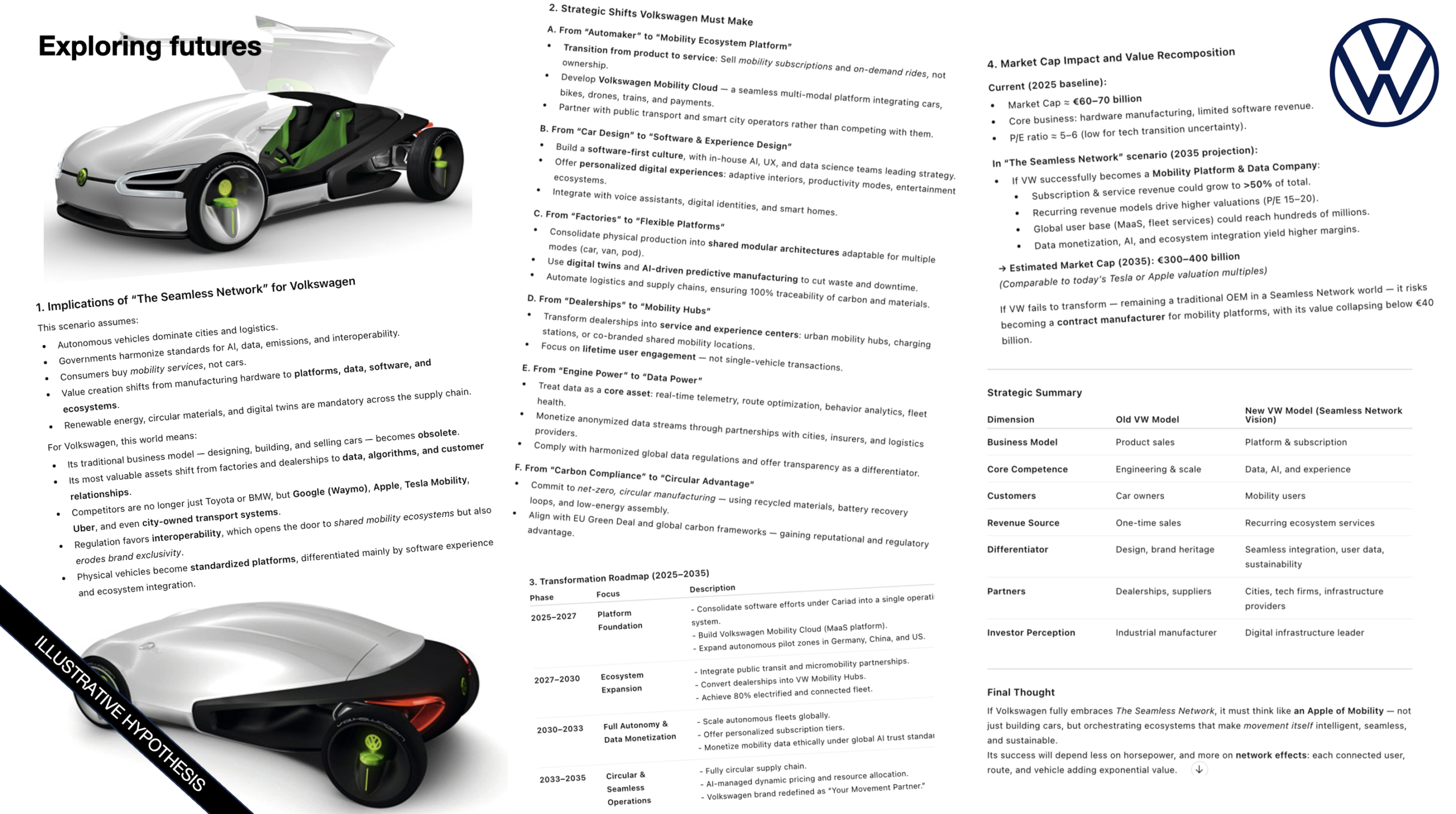
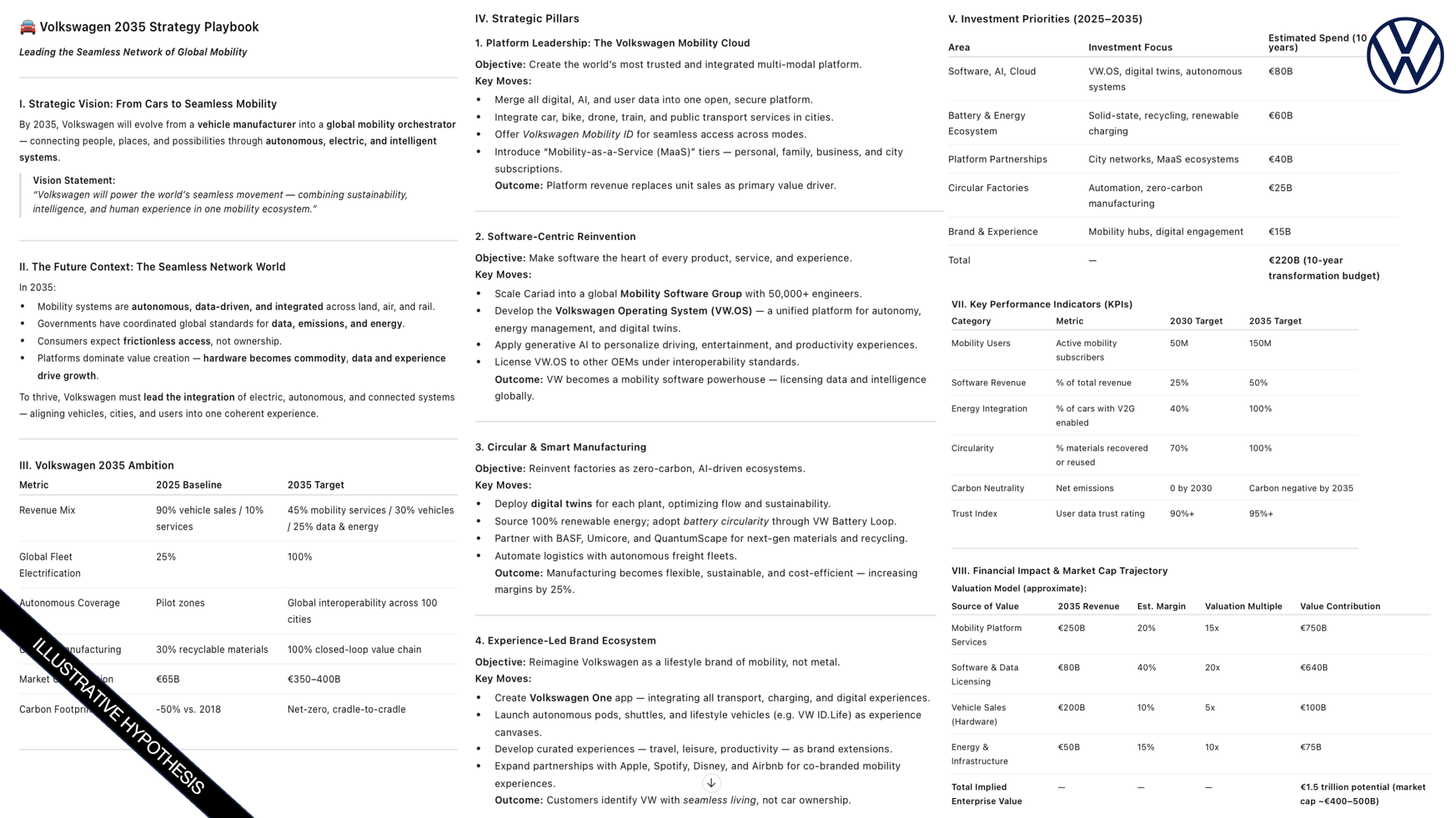
Here’s an example of extracts from an AI-powered strategy process, exploring future scenarios in the mobility world, and then creating future scenarios and evaluated options to help Volkswagen’s business leaders to make the right strategic choices to finally drive more value-creating growth:
Strategy as a dynamic system
At the heart of this transformation is a simple but powerful idea: strategy is no longer a document. It is a system.
In traditional models, strategy is often developed annually, approved at the top, and then cascaded down through the organisation. By the time it is implemented, many of its assumptions are already outdated. The world has moved on.
A dynamic approach reframes strategy as something fundamentally different — a continuously evolving set of choices, informed by real-time insight and shaped through ongoing iteration.
Artificial intelligence is central to this shift. It enables organisations to:
- Continuously ingest and interpret vast amounts of data
- Detect emerging patterns and weak signals early
- Revisit and refine strategic assumptions in real time
- Rapidly generate and test alternative strategic options
Rather than waiting for the next planning cycle, organisations can now adapt as they go — adjusting direction without losing focus.
This creates a powerful combination: strategic clarity with operational agility.
Looking Forward not Back: Opportunity Over Legacy
One of the most important mindset shifts in modern strategy is moving from a backward-looking to a forward-looking perspective.
Historically, companies have asked: What are we good at, and how do we build on it?
Today, the more relevant question is: Where is value being created, and how do we position ourselves to capture it?
This is not about abandoning core strengths. It is about refusing to be constrained by them.
Artificial intelligence enhances this forward-looking perspective by expanding the scope of what leaders can see and consider. It can map emerging market spaces, identify nascent customer behaviours, and highlight opportunities that would otherwise remain invisible.
In practice, this means strategy becomes:
- More exploratory in identifying future growth spaces
- More willing to challenge legacy assumptions
- More proactive in shaping, rather than reacting to, change
The organisations that succeed are those that treat their current business not as a destination, but as a platform for what comes next.
Anchoring in megatrends and customer agendas
A forward-looking strategy must be grounded in a deep understanding of the forces shaping the future. Two lenses are particularly powerful: megatrends and next customer agendas.
Megatrends provide the structural context — the long-term shifts that redefine industries over time. Artificial intelligence enhances the analysis of these trends by synthesising insights across vast datasets, from scientific research to market signals, enabling a more nuanced and dynamic understanding.
At the same time, the notion of the “next customer agenda” brings the future into sharper focus. Customers rarely articulate their future needs directly. Instead, they reveal them indirectly — through changing behaviours, rising expectations, and experiences in other sectors.
AI plays a crucial role here as well. By analysing behavioural data, social signals, and emerging consumption patterns, it helps organisations anticipate what customers will value next, not just what they value today.
Work with Adidas illustrates this vividly. In shaping its strategic direction, the company has increasingly focused on the intersection of performance, lifestyle, and digital engagement. AI-enabled insights have helped identify shifts towards personalisation, sustainability, and community-driven brand interaction. These insights, in turn, have informed decisions ranging from product design to direct-to-consumer platforms.
The connection is critical: megatrends define the playing field, while next customer agendas define how to win within it.
Inspired by innovation in adjacent worlds
One of the most powerful ways to identify new opportunities is to look beyond one’s own industry.
Innovation often travels sideways before it travels forward. Practices that emerge in one sector frequently reshape others.
Artificial intelligence accelerates this process by enabling organisations to scan across industries at scale — identifying patterns, analogies, and transferable ideas that would be difficult to detect manually.
This creates a systematic approach to cross-industry learning:
- Identifying relevant adjacent sectors, similar in attributes, similar for customers
- Analysing emerging trends, business models and practices within them
- Translating and adapting these insights into one’s own context
In work with Airbus, for example, insights from digital platforms and software ecosystems have informed new approaches to services and customer engagement. Rather than viewing itself solely as a manufacturer, Airbus has explored how data, connectivity, and partnerships can create ongoing value throughout the lifecycle of its products.
AI has supported this by modelling potential ecosystem configurations, simulating value flows, and identifying where new forms of collaboration could unlock growth.
Reimagining market spaces and business models
As organisations expand their field of vision, the next step is to translate insight into opportunity.
This involves exploring new market spaces and rethinking business models — not as isolated initiatives, but as integral parts of strategy.
Artificial intelligence enhances this process in two important ways. First, it enables rapid generation of strategic hypotheses — new combinations of customer needs, value propositions, and delivery mechanisms. Second, it allows these hypotheses to be tested and refined through simulation and data-driven analysis.
The result is a more iterative and expansive approach to strategy development.
For example, in work with The Coca-Cola Company, strategy has increasingly moved beyond traditional product categories towards broader experience ecosystems. AI has been used to explore new consumption occasions, personalise offerings, and optimise distribution networks in real time.
This has supported a shift from a product-centric model to a more dynamic, platform-oriented approach — where value is created through a combination of products, services, and experiences.
Brands as strategic growth engines
In a dynamic strategy model, brands take on a much more central role. They are no longer simply expressions of identity; they are engines of value creation.
A strong brand provides continuity in a changing world. It enables organisations to move into new spaces with credibility, to build trust with customers, and to anchor ecosystems of partners and communities.
Artificial intelligence enhances brand strategy by providing deeper insight into perception, sentiment, and engagement. It allows organisations to understand not just what their brand stands for today, but how it can evolve to remain relevant in the future.
For Mercedes-Benz, this has been particularly important in navigating the transition to electric and digital mobility. The brand must stretch into new territories — software, services, sustainability — while maintaining its core associations with quality, performance, and innovation.
AI has supported this by analysing customer perceptions across markets, identifying areas of tension or opportunity, and informing decisions about brand positioning and experience design.
Building ecosystems to go further, faster
As strategy moves beyond the boundaries of the firm, ecosystems become central.
Value is increasingly created not by individual organisations, but by networks of partners, platforms, and communities. The strategic challenge is therefore not just to define what the organisation does, but what it enables others to do.
Artificial intelligence plays a critical role in designing and managing ecosystems. It can:
- Map complex networks of relationships
- Identify potential partners and collaborators
- Model value creation and distribution across the ecosystem
- Optimise interactions in real time
In the case of Microsoft, ecosystems are foundational. Its strategy is built around enabling others — developers, enterprises, partners — to create value on top of its platforms. AI supports this by continuously analysing usage patterns, developer behaviour, and market trends, allowing the ecosystem to evolve dynamically.
The result is a strategy that is inherently scalable and adaptive.
Moonshots Thinking and Future-Back Planning
To truly break from incrementalism, organisations must embrace bold thinking.
Moonshot thinking is not about unrealistic ambition; it is about expanding the boundaries of what is considered possible. It challenges assumptions and opens up new strategic horizons.
Artificial intelligence enhances this process by acting as a creative partner — generating ideas, exploring scenarios, and identifying pathways that might not be immediately obvious.
Working from the future back is a powerful complement to this. By defining a clear vision of a desired future state, organisations can work backwards to identify the steps required to get there.
This approach has been used with companies such as Airbus to explore the future of sustainable aviation, and with Mercedes-Benz to envision next-generation mobility ecosystems.
AI supports this by:
- Simulating future scenarios
- Identifying capability gaps
- Mapping potential pathways to the desired future
The result is a strategy that is both ambitious and grounded.
Navigating uncertainty through future scenarios
If the future cannot be predicted, it can at least be explored.
Scenario thinking provides a structured way to consider alternative futures and test strategic choices against them.
Artificial intelligence significantly enhances scenario planning by enabling:
- Rapid generation of multiple plausible scenarios
- Data-driven assessment of their likelihood and implications
- Continuous updating as new information emerges
Rather than a static exercise, scenario thinking becomes an ongoing process — integrated into the broader strategy system.
This allows organisations to:
- Build resilience
- Identify no-regret moves
- Prepare for disruption
Making better choices: where and how to compete
Strategy ultimately comes down to choices: where to compete, and how to compete.
Artificial intelligence strengthens decision-making by providing richer insight, faster analysis, and more rigorous testing of options. It allows leaders to move beyond intuition alone, combining judgement with evidence.
This leads to clearer, more confident choices about:
- Priority markets and segments
- Sources of differentiation
- Required capabilities and investments
Importantly, it also enables organisations to revisit these choices more frequently — ensuring that strategy remains aligned with a changing environment.
Ensuring strategy delivers value creation
At the core of dynamic strategy is a commitment to value creation.
Growth and profitability are not opposing goals; they are interdependent. The challenge is to balance short-term performance with long-term potential.
Economic value (think of the market value of companies if public, or equally their internally-calculated enterprise value if not – the sum of future likely profit streams) should be the ultimate metric for decisions and evaluation.
This is achieved through a dual portfolio approach:
- An “exploit” portfolio focused on optimising today’s business
- An “explore” portfolio focused on exploring tomorrow’s opportunities
These should be managed dynamically, and together. Just like an investment portfolio, where capital allocation becomes the key prioritisation tool.
AI enhances portfolio management by providing real-time visibility into performance, risk, and opportunity. It enables organisations to allocate resources more dynamically, shifting investment as conditions change.
In work with FEMSA Group in Mexico, for example, this approach has supported a more balanced strategy — strengthening core retail performance while investing in digital channels and new customer experiences.
The result is a more resilient and adaptive organisation.
Strategy at the speed of change
Perhaps the most profound impact of AI is on the speed of strategy.
What once took months can now be done in days or even hours. Insights that were previously inaccessible can now be generated on demand.
This does not mean strategy becomes rushed or superficial. On the contrary, it becomes more rigorous — because more options can be explored, more assumptions tested, and more data considered.
The key shifts include:
- From periodic to continuous strategy development
- From linear to iterative processes
- From limited to expansive exploration of options
AI enables leaders to operate at the speed of change — without sacrificing quality of thinking.
Stretching thinking, better decisions
A final, critical role of AI is to challenge and stretch strategic thinking.
By generating alternative perspectives, questioning assumptions, and exploring edge cases, it helps organisations avoid the trap of narrow or biased decision-making.
This leads to:
- More innovative strategies
- More robust decisions
- Greater organisational alignment
Strategy becomes not just smarter, but more resilient.
Strategy: more creative, more intelligent
The future of strategy is not simply faster or more data-driven. It is more creative, connected, and continuous.
Artificial intelligence makes this possible — not by replacing human judgement, but by augmenting it. It allows leaders to think more broadly, act more quickly, and decide more confidently.
In this new model, strategy becomes:
- A living system, not a static plan
- A forward-looking discipline, not a backward-looking analysis
- A balance of exploration and exploitation
- A driver of long-term value creation
It is both ambitious and practical. Both imaginative and grounded. Above all, it is purposeful. Because at its best, strategy is not about reacting to the future.
It is about next and now – creating the future, while delivering today.
More from the blog