Future Makers … bold businesses with courageous leaders, who are reimagining industries, harnessing frontier technologies, and turning impossible challenges into exponential growth and lasting impact
February 18, 2026
They do not wait for the future to arrive. They build it.
Across continents and categories, a new breed of company is shaking the foundations of established industries. They challenge orthodoxies that others treat as fixed. They dismantle legacy models without sentimentality. They fuse science, software and systems thinking. They take risks that feel uncomfortable, even reckless, to incumbents. And in doing so, they create dramatic new value.
These are the Future Makers … businesses with the courage to let go of the past and leap towards possibility.
- They do not pursue marginal gains. They reimagine entire markets.
- They combine technological depth with ecosystem design and industrial-scale execution.
- They solve problems that once felt impossible — from affordable space access to programmable biology, from carbon removal to AI-assisted drug discovery.
- They move quickly, iterate boldly, and blend profit with purpose.
The future is not something they predict. It is something they engineer.
Rewriting the Rules of Intelligence
Few domains are shifting faster than artificial intelligence. Yet the most interesting players are not merely racing for scale; they are redefining responsibility.
Anthropic has positioned itself at the frontier of AI capability while embedding safety and alignment at its core. Its Claude models compete with the most advanced systems in the world, but the company’s strategic bet is that trust will define long-term leadership. In a world increasingly shaped by autonomous systems, reliability and governance are not constraints — they are competitive advantages. Anthropic reframes the AI race from raw power to principled intelligence.
Future Makers understand that the next wave of value creation will belong to those who can make powerful technologies usable, trusted and scalable.
Powering the Digital Backbone
Some Future Makers are invisible to consumers yet indispensable to progress.
The Dutch company ASML builds the extreme ultraviolet lithography machines that produce the world’s most advanced semiconductors. Each system is a masterpiece of precision engineering, the result of collaboration across physics, materials science and global supply chains. Without ASML, there are no leading-edge chips. Without those chips, there is no AI revolution, no high-performance computing, no next-generation connectivity.
ASML does not dominate headlines, but it occupies a critical node in the global ecosystem. It exemplifies a defining Future Maker trait: control the enabling architecture, and you shape the trajectory of entire industries.
Electrifying Mobility at Scale
The automotive sector once evolved incrementally — engine improvements, design refinements, efficiency gains. Then electrification arrived, and with it a systemic shift.
China’s BYD recognised early that batteries would sit at the heart of the new mobility economy. Originally a battery manufacturer, it vertically integrated into vehicle production, software and global distribution. By mastering battery chemistry and manufacturing scale, BYD has accelerated past many traditional carmakers.
This is not a niche transition. It is industrial reinvention. BYD’s growth reflects a broader lesson: when a technology curve turns exponential, partial commitment is fatal. Future Makers commit fully.
Programming Humanity
In healthcare, the convergence of computation and life sciences is unlocking extraordinary possibilities.
Germany’s BioNTech built its capabilities around mRNA technology long before it became a household name. When the pandemic struck, it pivoted rapidly to develop one of the first COVID-19 vaccines. Yet its deeper mission lies in personalised cancer therapies and programmable medicine.
Similarly, Insilico Medicine applies artificial intelligence to drug discovery, compressing timelines that once stretched over a decade. By analysing biological data at scale, it identifies targets and designs molecules with unprecedented speed.
Here, biology becomes code. Discovery becomes computation. Future Makers in health are not simply developing treatments — they are redesigning the innovation engine itself.
Democratising Creativity
Transformation is not confined to heavy industry or biotech. It also reshapes how people express ideas.
Australia’s Canva turned professional-grade design into an intuitive, collaborative platform accessible to millions. By removing complexity and lowering cost barriers, it expanded the market dramatically. Teachers, entrepreneurs and global enterprises alike now use Canva to communicate visually.
This is a powerful Future Maker insight: growth often comes not from stealing share, but from unlocking latent demand. By empowering participation, markets multiply.
Reinventing Food Systems
Feeding a growing population sustainably demands radical innovation.
Chilean-founded NotCo uses artificial intelligence to analyse plant molecules and recreate the taste and texture of animal-based products. Its algorithm identifies unexpected ingredient combinations, producing alternatives that appeal to mainstream consumers.
Rather than framing plant-based food as sacrifice, NotCo reframes it as superior design. It blends data science with culinary creativity to challenge a centuries-old food system. Sustainability becomes not a constraint, but a driver of competitive advantage.
Removing Carbon from the Sky
Some challenges are planetary in scale.
Swiss company Climeworks develops direct air capture technology to remove carbon dioxide from the atmosphere. Its facilities represent a shift from mitigation alone to active restoration. By building a commercial model around long-term carbon removal contracts, Climeworks aligns environmental necessity with financial sustainability.
I went to visit their Mammoth location in Iceland, the largest direct air capture facility in the world. The scale of their ambition, the creativity of their business model, the impact they could have on accelerating our ability to solve the climate crisis, are truly impressive.
Future Makers understand that climate action is not peripheral to business strategy. It is central to future value creation.
Orchestrating Digital Ecosystems
Many of today’s most powerful companies do not own the assets they monetise. They orchestrate connections.
Instacart layered digital infrastructure over physical grocery retail, connecting consumers, supermarkets and logistics partners. What began as delivery evolved into advertising, analytics and enterprise technology services. Once embedded in the value chain, new revenue streams emerge naturally.
In China, Ping An transformed from a traditional insurer into a technology-powered ecosystem spanning finance, healthcare and smart city services. By embedding AI and digital platforms across its operations, it shifted from reactive insurance to proactive life management.
Future Makers think beyond products. They design systems in which others participate.
Expanding the Frontier
Some companies pursue ambitions that stretch beyond Earth itself.
SpaceX redefined the economics of space by developing reusable rockets. Through relentless iteration — launch, fail, learn, repeat — it drove down costs and increased launch frequency. Its Starlink satellite constellation extends connectivity to remote regions, building a parallel communications infrastructure in orbit.
Or take Rocket Lab, who seek to do it all with 3D printing, dramatically reducing the costs, enabling more experimentation, and access to companies and nations who could only dream of space.
This is moonshot thinking executed with engineering discipline. Space becomes not the preserve of governments, but a commercial and entrepreneurial domain.
Building Connected Worlds
In consumer technology, ecosystems matter more than individual devices.
China’s Xiaomi combined community-driven branding with online distribution to scale rapidly in smartphones. It then expanded into a vast array of connected home devices, creating an integrated Internet of Things ecosystem. More recently, it has entered electric vehicles, signalling ambitions that transcend electronics.
Xiaomi’s strategy illustrates how data, design and platform integration can transform hardware into recurring, ecosystem-based value.
The Shared DNA of Future Makers
Across sectors and geographies, these companies share defining characteristics.
- They anchor themselves in transformative technologies and invest ahead of the curve.
- They design ecosystems rather than isolated offerings.
- They execute with industrial discipline, not just visionary rhetoric.
- They are willing to cannibalise legacy models in pursuit of exponential growth.
- They integrate purpose into strategy, attracting talent and capital aligned with long-term impact.
- They move with urgency, treating learning as a competitive weapon.
Above all, they possess leadership with courage — leaders willing to abandon yesterday’s success formulas and embrace uncertainty.
The future does not reward complacency. It rewards builders.
Future Makers are not waiting for disruption to arrive at their door. They are the disruption. They are engineering new markets, redefining value, and proving that growth and impact can advance together.
In every sector, from chips to climate, from finance to food, they remind us of a simple truth: the future belongs to those bold enough to create it.
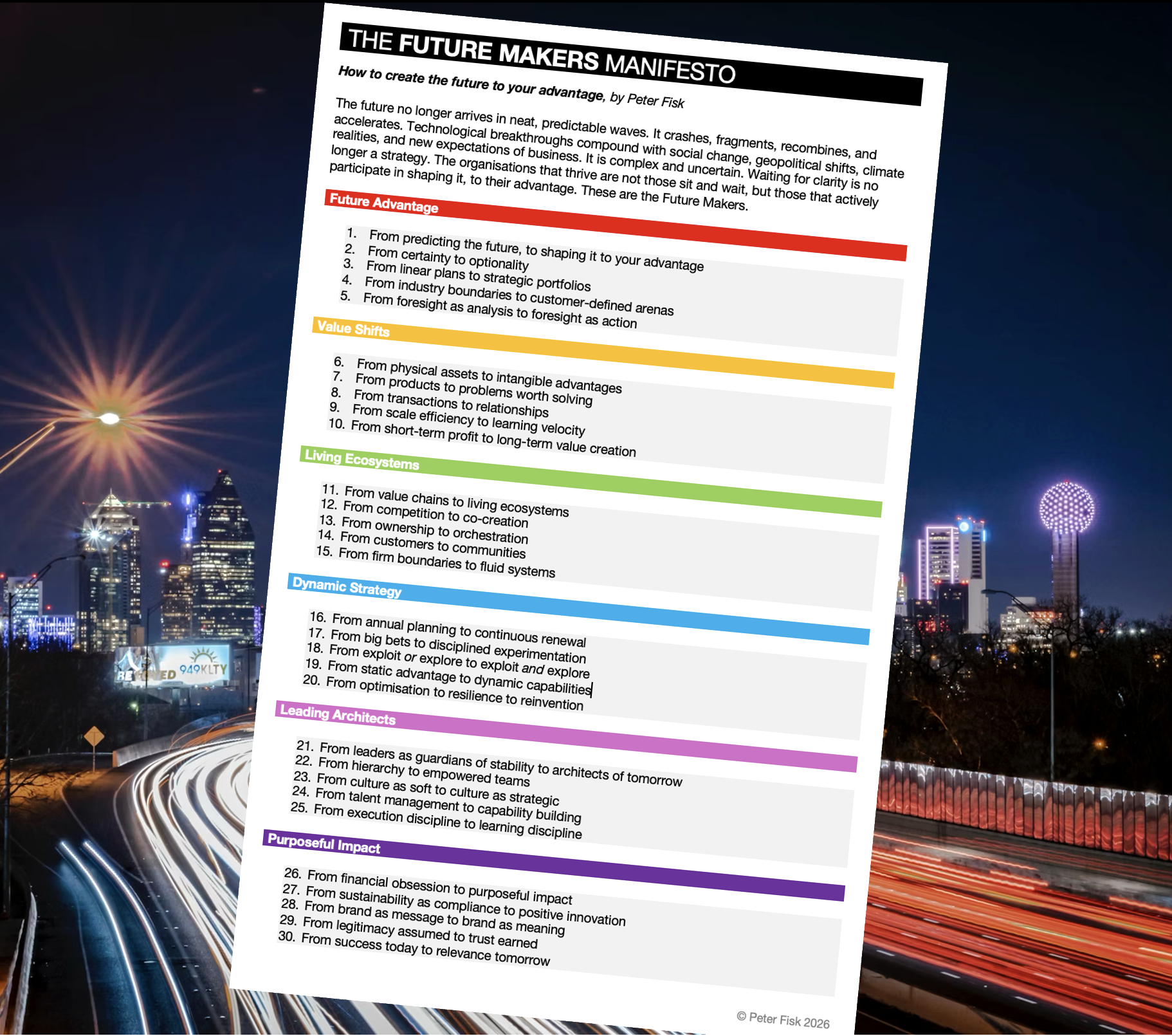
The Future Makers Manifesto
To the future makers of the world:
You are not inheriting a stable playing field. You are stepping into motion.
The future no longer arrives in neat, predictable waves. It crashes, fragments, recombines and accelerates. Artificial intelligence reshapes knowledge work while climate volatility redraws supply chains. Demographics shift, geopolitics fractures, trust in institutions fluctuates, and customer expectations rise faster than quarterly reporting cycles can accommodate. Technology no longer sits on the edge of strategy; it is strategy. Purpose is no longer a marketing line; it is licence to operate.
Complexity is not a passing phase. Uncertainty is not a temporary disturbance. They are the conditions of modern business.
Waiting for clarity is no longer a strategy.
The organisations that thrive in this environment are not those that sit back and attempt to predict what comes next with ever more detailed forecasts. They are the ones that step forward and shape it. They invest before certainty. They experiment before consensus. They build capabilities before the market fully forms. They do not merely respond to disruption; they harness it.
These are the Future Makers:
Future Advantage
1. From predicting the future, to shaping it to your advantage
Forecasting has limits in turbulent systems. Future Makers move beyond prediction to proactive design. They influence standards, invest in emerging technologies, build narratives that shape customer expectations, and partner to create new markets. Rather than asking what will happen, they ask how they can tilt probabilities in their favour.
2. From certainty to optionality
In volatile environments, rigid commitment is risk. Optionality – investments, partnerships and capabilities that keep multiple pathways open – is strategic insurance. Small stakes in new technologies, flexible supply chains, modular platforms and adaptable talent models provide room to manoeuvre as conditions shift.
3. From linear plans to strategic portfolios
Five-year linear plans struggle against exponential change. Future Makers manage portfolios: core optimisation, adjacent expansion and transformational bets. Each has different metrics, horizons and risk profiles. The discipline lies in balancing them, reallocating capital dynamically as evidence emerges.
4. From industry boundaries to customer-defined arenas
Customers do not experience “industries”; they experience needs. Mobility, wellbeing, productivity, entertainment – these cut across sectors. Future Makers redefine their competitive arena around customer problems, not legacy classifications, enabling cross-sector innovation and unexpected growth.
5. From foresight as analysis to foresight as action
Insight without execution is theatre. Scenario planning, trend analysis and technology scouting must translate into pilots, partnerships and prototypes. Foresight becomes valuable only when embedded into capital allocation, innovation pipelines and leadership agendas.
Value Shifts
6. From physical assets to intangible advantages
Brands, data, intellectual property, culture and ecosystems now drive disproportionate value. Future Makers systematically build and measure these intangibles, recognising that trust, reputation and proprietary insight create more durable advantage than bricks and mortar alone.
7. From products to problems worth solving
Customers hire solutions, not items. By deeply understanding pain points and aspirations, organisations move beyond selling units to delivering outcomes. This shift unlocks service models, recurring revenues and deeper loyalty.
8. From transactions to relationships
Digital connectivity enables ongoing engagement. Future Makers design lifetime journeys, not one-off sales. Data, personalisation and community-building transform episodic interactions into continuous relationships that generate mutual value.
9. From scale efficiency to learning velocity
Efficiency remains important, but in fast-moving markets, the ability to learn rapidly is decisive. Agile methods, rapid experimentation, real-time analytics and empowered teams accelerate feedback loops, enabling quicker adaptation than larger, slower rivals.
10. From short-term profit to long-term value creation
Quarterly earnings matter, but enduring enterprises balance immediate performance with investments in innovation, capability and trust. Long-term orientation attracts committed stakeholders and builds resilience against shocks.
Living Ecosystems
11. From value chains to living ecosystems
Linear supplier-to-customer chains are giving way to dynamic networks of partners, platforms and communities. Future Makers cultivate ecosystems where multiple actors co-create value, increasing reach and innovation capacity.
12. From competition to co-creation
Collaboration with former rivals, start-ups, universities and even customers accelerates innovation. Co-creation expands opportunity spaces beyond what any single firm could achieve alone.
13. From ownership to orchestration
Control of every asset is no longer essential. Strategic advantage often lies in orchestrating complementary capabilities across partners. Platform thinking, APIs and shared standards enable scalable coordination without full ownership.
14. From customers to communities
Communities offer belonging, advocacy and insight. Future Makers nurture spaces – physical or digital – where customers connect with each other, deepening loyalty and generating organic growth.
15. From firm boundaries to fluid systems
Talent, ideas and capital flow across porous organisational borders. Open innovation, remote collaboration and flexible partnerships create adaptive systems that respond faster than closed hierarchies.
Dynamic Strategy
16. From annual planning to continuous renewal
Strategy cycles shrink. Continuous scanning, quarterly reprioritisation and rolling resource allocation replace static annual plans, keeping organisations aligned with evolving realities.
17. From big bets to disciplined experimentation
Transformational ambition is pursued through staged experiments. Clear hypotheses, defined metrics and rapid iteration reduce risk while enabling bold moves.
18. From exploit or explore to exploit and explore
Future Makers design ambidextrous organisations: optimising the core while exploring new growth engines. Structural separation, tailored incentives and leadership attention ensure both thrive.
19. From static advantage to dynamic capabilities
Sustainable success depends on the ability to reconfigure assets and competencies repeatedly. Learning, integration and transformation capabilities become the true source of advantage.
20. From optimisation to resilience to reinvention
Efficiency is necessary but insufficient. Resilience absorbs shocks; reinvention creates new trajectories. Future Makers build organisations capable not only of surviving disruption but of emerging stronger from it.
Leading Architects
21. From leaders as guardians of stability to architects of tomorrow
Leadership shifts from preserving the status quo to designing future systems. Courage, curiosity and clarity of purpose replace control as defining traits.
22. From hierarchy to empowered teams
Speed demands decentralised decision-making. Empowered, cross-functional teams close to customers act faster and innovate more effectively than rigid hierarchies.
23. From culture as soft to culture as strategic
Culture shapes behaviour at scale. Intentional norms around experimentation, accountability and collaboration become critical enablers of strategic ambition.
24. From talent management to capability building
Rather than simply acquiring talent, Future Makers continuously develop capabilities – digital fluency, systems thinking, adaptive leadership – ensuring the organisation evolves with its environment.
25. From execution discipline to learning discipline
Delivering plans is vital, but so is learning from outcomes. Embedding reflection, feedback and adaptation into operating rhythms strengthens long-term performance.
Purposeful Impact
26. From financial obsession to purposeful impact
Profit remains essential, yet it is framed as outcome, not sole aim. Clear purpose guides decision-making, inspires stakeholders and anchors long-term direction.
27. From sustainability as compliance to positive innovation
Environmental and social challenges become catalysts for new products, services and business models. Regeneration and circularity drive growth rather than constrain it.
28. From brand as message to brand as meaning
Brand lives in behaviour. Authentic actions, consistent experiences and transparent communication build meaning that resonates beyond advertising.
29. From legitimacy assumed to trust earned
In an era of scrutiny, trust must be continuously earned through integrity, data responsibility, fair practices and social contribution.
30. From success today to relevance tomorrow
Past achievement offers no immunity. Future Makers constantly ask how they will remain relevant in a decade’s time, designing pathways to sustained significance.
More from the blog