The New Leadership DNA: the ability to create tomorrow, and deliver today … in a time of uncertainty, complexity and change, foresight, courage and reinvention are the defining acts of leadership
February 22, 2026

End of excuses, time to step up
There are long periods in business history when leadership is largely about stewardship — protecting assets, optimising performance, and extending what already works. And then there are moments when leadership becomes something far more demanding: the deliberate act of redesigning the future while the present is still in motion.
We are entering one of those moments.
As 2026 approaches, leaders face a rare and uncomfortable paradox. The opportunity to reinvent business has never been greater. AI and data, new platforms and ecosystems, and converging technologies are unlocking possibilities that would have seemed implausible only a few years ago. At the same time, the conditions for success have never been tougher.
Capital is expensive. Geopolitics are unstable. Regulation is tightening. Climate pressure is intensifying. Trust in institutions, brands, and leaders, is fragile. The margin for strategic error has vanished.
The early 2020s were defined by what might be called the great experimentation. Organisations everywhere launched pilots, innovation labs, digital initiatives, sustainability programmes, and transformation roadmaps. Some created real value. Many created activity without traction.
2026 marks a turning point. This is the year when experimentation gives way to accountability — when ambition must translate into performance, when narratives must be backed by results, and when leaders are judged on their ability to deliver today and shape tomorrow.
Having worked with CEOs and leadership teams across industries and in every part of the world – from Italian food to Mexican retail, Moroccan fertiliser to Swiss cement, Japanese insurance and German sportswear – one truth is increasingly clear: the leaders pulling ahead are not those with the most technology, but those redefining what leadership itself means.
From hype to hard choices
The hype phase of generative AI is over. That does not diminish its importance — it sharpens it.
Boards and investors are no longer impressed by pilots or demonstrations. They want proof: productivity gains, margin improvement, faster cycle times, and more resilient business models. The question has shifted from “What could this technology do?” to “What value is it creating — and at what cost?”
At the same time, leaders are navigating a world shaped by structural volatility rather than episodic shocks. Global efficiency is being replaced by regional resilience. Consumer markets are splitting into premium and value extremes. Sustainability is shifting from optional ESG to mandatory compliance and competitive advantage.
Uncertainty and complexity has become a poor excuse for inaction. In this environment, leadership is no longer about managing trade-offs at the margins. It is about making decisive choices early — and standing behind them.

Foresight: sensing what others miss
The first defining capability of leadership in 2026 is foresight.
Foresight is not prediction. It is the disciplined ability to sense what is emerging, imagine multiple futures, understand where value is shifting, and act before change becomes obvious.
I recently worked with the CEO of Europe’s largest construction and infrastructure company — a sector often viewed as conservative and cyclical. Investors were pressuring the business on margins, capital intensity, and environmental exposure. The instinctive response would have been defensive cost-cutting.
Instead, the leadership team reframed the company’s future around the megatrends reshaping construction itself: decarbonisation, urban resilience, digital twins, modular building, and climate adaptation. Sustainability moved from being treated as a regulatory cost to becoming the platform for innovation, differentiation, and long-term growth.
This shift reshaped investment priorities, partnerships, and capabilities — and gave investors a credible logic for why the company would win over the next decade, not just survive the next cycle.
That is foresight in action: turning intimidating uncertainty into strategic advantage.
Courage: choosing before certainty
Foresight without courage achieves very little.
Every meaningful transformation involves risk — to short-term performance, to reputation, and often to personal standing. Yet many leaders still default to incrementalism, hoping to delay hard decisions until conditions improve.
They rarely do.
The leaders accelerating ahead in 2026 are those willing to exit businesses that no longer have a future, cannibalise existing revenue before competitors do, reallocate capital away from legacy assets, and say no to initiatives that create motion but not value.
In the Middle East, I worked with the CEO of one of the region’s largest food companies. The business had scale, trusted brands, and deep distribution — yet much of its value was trapped in underleveraged intangible assets.
Rather than simply expanding capacity or pushing price, the leadership team reimagined how the company could unlock its brands, data, and capabilities through new business formats: direct-to-consumer platforms, health-led propositions, premium sub-brands, and ecosystem partnerships. This required challenging deeply held assumptions about what business they were really in.
That courage created friction — and momentum.
Business reinvention: redefining what you are
Beyond foresight and courage lies the real work of leadership today: business reinvention.
Reinvention is not about transformation programmes or digital upgrades. It is about rethinking the fundamentals of the enterprise:
- Why does this business exist now?
- How does it define itself — and how must that definition evolve?
- Where is real value created, and where is it being eroded?
- How will value be captured in a world shaped by AI, regulation, and new expectations?
The most effective leaders are reinventing their businesses across three dimensions.
- Strategy. Moving beyond defending positions to designing future portfolios of value, often across industry boundaries.
- Business models. Shifting from linear models to platforms, services, subscriptions, and ecosystems — from selling products to delivering outcomes.
- Innovation everywhere. Embedding innovation across operations, supply chains, pricing, partnerships, talent models, and customer experience — not just in labs.
In Asia, I worked with the CEO of one of the region’s largest insurance companies facing slowing growth and rising claims volatility. Incremental product innovation was no longer enough. The opportunity lay in reconfiguring the business around prediction rather than reaction.
By harnessing AI and advanced analytics, the company began shifting toward prevention-based services — anticipating health risks, climate exposure, and customer needs before they materialised. This was not a technology upgrade. It was a reinvention of what insurance meant.
Reinvention demands a different way of thinking — and a different way of working.
Many organisations are constrained not by a lack of ideas, but by the gravitational pull of past success. Leaders must cultivate curiosity beyond their comfort zone — learning from adjacent sectors, emerging markets, and unconventional competitors.
Equally, strategy itself must change. In a volatile world, strategy cannot be an annual ritual. It must become a dynamic, agile process — continuously sensing change, testing options, reallocating resources, and learning in real time. This means shorter planning cycles, scenario-based decisions, clear strategic intent paired with empowered execution, and constant feedback loops.
The role of leadership shifts from setting a fixed destination to orchestrating continuous movement.
Reconnecting with customers
One of the most underestimated leadership challenges today is the changing nature of the customer relationship.
Trust is eroding — in institutions, technology, media, and brands — while customer expectations continue to rise. People now expect relevance, personalisation, transparency, speed, empathy, and value, often simultaneously. At the same time, customers are fragmenting into sharply divergent groups with very different priorities and definitions of value.
Gen Z consumers seek authenticity, participation, and values alignment. They are sceptical of polished brand claims, fluent in digital culture, and motivated by experience, community, and meaning as much as price. At the other end of the spectrum, aging populations prioritise reassurance, wellbeing, simplicity, and trust, often preferring human interaction over frictionless automation. Between these poles sits a broad middle: value-conscious, volatility-weary customers exhausted by years of economic uncertainty.
For leaders, the challenge is not simply better segmentation or more personalisation. It is how to engage customers with divergent agendas without fragmenting the business beyond coherence.
Leading organisations are responding by moving beyond transactional engagement toward relationship-based models. They are redefining their role — from seller to partner, from provider to coach, from brand to platform or community. This shift is particularly visible in the rise of wellness-led propositions, where businesses move upstream from solving problems to helping customers prevent them. Wellness is no longer a lifestyle trend; it is becoming a strategic lens across food, insurance, retail, finance, and technology.
At the same time, gamification is emerging as a powerful engagement tool — not as superficial entertainment, but as a way to motivate behaviour, sustain participation, and make progress visible. Combined with this is a growing human premium. In a world saturated with AI-generated content, trust increasingly depends on transparency, ethics, and visible human judgement.
In a low-trust, high-expectation world, engaging customers is no longer a marketing task. It is a leadership responsibility — and a critical source of long-term value creation.
Talent and the human premium
Technology may be advancing exponentially, but leadership remains profoundly human.
In fact, the more synthetic the world becomes, the more valuable authentic human leadership is.
Organisations in 2026 face a series of intertwined talent challenges:
- An entry-level gap as AI automates junior work
- Rising expectations around purpose, flexibility and meaning
- Increasing competition for scarce digital and creative skills, and new models of work
The most effective leaders are responding by consciously designing environments where people can learn, grow and contribute — not just execute tasks.
They are also recognising what I call the human premium: the ability to create trust, judgement, empathy and creativity in a world saturated with algorithms.
This applies not only internally, but also to customers. As AI-generated content and virtual interactions proliferate, brands that can guarantee genuine human connection will command disproportionate loyalty and pricing power.
This challenge can’t be addressed in isolation. We need to engage talent, build new capabilities and mindsets, in the context of this new complexity, and exciting opportunities.
Inspiring investors in an age of scepticism
One of the most underestimated leadership challenges in 2026 is communication — not marketing, but strategic credibility.
Investors are more sceptical than ever. They have heard the promises. They have seen the pilot projects. Now they want evidence that leaders can convert ambition into returns.
The leaders who are winning investor confidence do three things exceptionally well:
- They articulate a clear theory of value creation, explaining how trends translate into profit
- They show disciplined capital allocation, demonstrating tough choices, not just bold ideas
- They measure what matters, linking strategy to concrete performance indicators
Crucially, they also tell a story about the future that is grounded, not grandiose. In uncertain times, credibility beats charisma.
Most leaders are still unable or afraid to articulate a clear value creation logic. They find comfort in short term results, turnover and EBITDA, which keeps their organisations afloat. But they lack confidence to express options in terms of long-term enterprise value. While this requires a combination of intuition and analysis, it is the only way to make hard choices which combine short- and long-term thinking. And it is the language of investors.
Transformation as a superpower
Too many organisations still treat transformation as a project — something with a beginning, a middle and an end.
The leaders thriving in 2026 see it differently. For them, transformation is a core capability — a muscle that gets stronger with use. Transformation is much more than change, and demands skills far beyond change management. Transformation is a strategic journey of reinvention, a pivot, a new value logic, a new operating logic. It will connect many changes along the way, and these need to aligned and navigated coherently.
This means:
- Building organisations that can reconfigure quickly
- Embedding continuous learning
- Rewarding adaptability, not just efficiency
- Viewing disruption as fuel, not threat
The most successful transformations never stop. The best organisations continually reinvent themselves, creating the next generation of “s-curves” of change. Think of Netflix, constantly reinventing itself from DVDs by mail to online streaming, to content creation to gamification. Think of DSM, transforming itself from coal mining to chemicals, to life science and nutrition. Think of Fujifilm, from camera film to medical imaging, cosmetics to new drugs.
One CEO described it to me succinctly: “Our ability to change faster than our environment is now our only sustainable advantage.”
A leadership manifesto for accelerating change
In a world defined by accelerating AI, geopolitical volatility, climate pressure, and continuous business reinvention, business leaders must move from guardians of continuity to architects of transformation.
They must sense change early, act courageously, mobilise others, and continuously reinvent themselves and their organisations. These are not soft traits or abstract mindsets — they demand new leadership capabilities and decisive action.
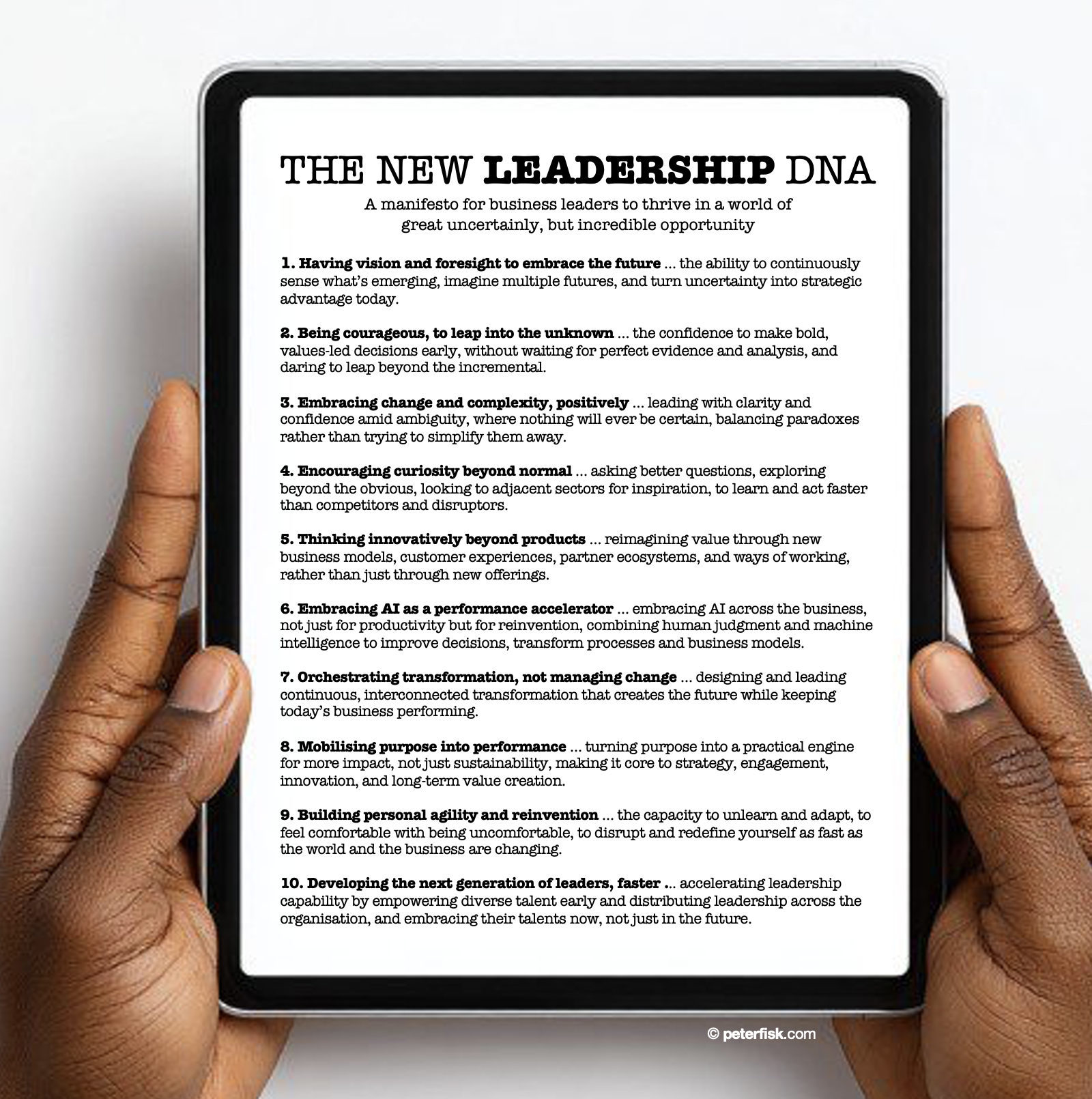
Here are my ten priorities for business leaders — a manifesto for a year of accelerating change:
1. Having vision and foresight to embrace the future … the ability to continuously sense what’s emerging, imagine multiple futures, and turn uncertainty into strategic advantage today.
- Megatrends 2035: 6 dramatic forces shaping the future of every market
2. Being courageous, to leap into the unknown … the confidence to make bold, values-led decisions early, without waiting for perfect evidence and analysis, and daring to leap beyond the incremental.
- The Courageous Leap: the moment when managers become leaders
3. Embracing change and complexity, positively … leading with clarity and confidence amid ambiguity, where nothing will ever be certain, balancing paradoxes rather than trying to simplify them away.
- Dynamic Strategy: combining bold direction with empowered agility
4. Encouraging curiosity beyond normal … asking better questions, exploring beyond the obvious, looking to adjacent sectors for inspiration, to learn and act faster than competitors and disruptors.
- 26 Trends for 2026: exploring changing consumers and businesses
5. Thinking innovatively beyond products … reimagining value through new business models, customer experiences, partner ecosystems, and ways of working, rather than just through new offerings.
- Next Generation Business Models: reinventing the way your business works
6. Embracing AI as a performance accelerator … embracing AI across the business, not just for productivity but for reinvention, combining human judgment and machine intelligence to improve decisions, transform processes and business models.
- The AI-Enabled Leader: how leaders lead differently, the best of humanity and tech
7. Orchestrating transformation, not managing change … designing and leading continuous, interconnected transformation that creates the future while keeping today’s business performing.
- Business Transformation: the new leadership superpower to reinvent business
8. Mobilising purpose into performance … turning purpose into a practical engine for more impact, not just sustainability, making it core to strategy, engagement, innovation, and long-term value creation.
- Turning Purpose into Profits: how purpose should drive the business
9. Building personal agility and reinvention … the capacity to unlearn and adapt, to feel comfortable with being uncomfortable, to disrupt and redefine yourself as fast as the world and the business are changing.
- Disrupt Yourself: what got you here, won’t take you further
10. Developing the next generation of leaders, faster ... accelerating leadership capability by empowering diverse talent early and distributing leadership across the organisation, and embracing their talents now, not just in the future.
- Leading Next Now: what’s new and next in leadership
Leadership in this world matters more than ever. Not to manage the status quo, but to create the future. Too many business leaders pose uncertainty, complexity and relentless change, as excuses not to make the hard decisions, the strategic leaps. But now is the time for leaders to step up, with creativity and courage. To create a better future, and start making it happen.
© Peter Fisk 2026
Email: peterfisk@peterfisk.com
More from the blog