Reinventing Strategy … How organisations embraced “adaptive strategy” … learning how to learn, evolve, and thrive in a world that refuses to stand still
January 21, 2025

Strategy gets adaptive
For most of the twentieth century, strategy was built on a simple premise: the world moved slowly enough for leaders to analyse it, anticipate it, and plan their response in advance. Annual cycles of planning and budgeting were deemed not only adequate but sophisticated. Large organisations took pride in their ability to predict, control, and optimise. Business schools taught frameworks that assumed relative stability. Consultants helped refine plans and allocate capital. Boards looked for steady hands and long-term clarity.
All of this worked, until it didn’t.
From the mid-1990s onwards, a series of structural shifts—globalisation, digitisation, the internet, and the early rise of China—began to compress competitive cycles. What used to change slowly now began to change annually. Then quarterly. Then continuously. The 2010s brought artificial intelligence, mobile-first economies, new business models, platforms, ecosystems, and a wave of disruptive entrants operating with levels of speed and flexibility that traditional organisations simply could not match. Consumer expectations soared. Technologies converged. Regulatory pressures intensified. And the arrival of the COVID-19 pandemic made volatility not an anomaly, but a baseline expectation.
It became painfully clear that the old model of strategy—predict, plan, execute—was no longer enough. The world had become too complex, too interconnected, and too fast-moving for static plans to survive contact with reality.
In response, a different idea began to emerge—one that has roots in ecology, organisational learning, systems thinking, and modern innovation practice. It is the idea that strategy itself must become adaptive: a living, learning process rather than a rigid plan; a way of thinking rather than a document; a continuous flow of sensing, interpreting, acting, and adjusting rather than a single moment of grand design.
Adaptive strategy is not a buzzword. It is the consequence of a world where certainty has collapsed. It is what happens when organisations learn to breathe with the environment rather than stand apart from it. It blends direction with iteration, ambition with humility, foresight with experimentation. It is the recognition that strategy must guide but never constrain; must set intent but allow freedom; must define priorities but leave space for discovery.
This article explores where the idea came from, what it means, how it works in practice, what tools make it possible, how leading organisations around the world apply it, and why it reshapes not only performance but culture, leadership, and organisational identity.
Understanding nature
Although “adaptive strategy” has become a staple of contemporary business vocabulary, it did not begin in business at all. Its earliest roots lie in environmental science and systems ecology.
The Ecological Foundations
In the 1970s, the Canadian ecologist C.S. “Buzz” Holling and his colleagues at the International Institute for Applied Systems Analysis (IIASA) developed the idea of adaptive management. Their concern was not competition or markets but ecosystems—complex, dynamic, interdependent environments that defied prediction. Holling observed that ecosystems behave in non-linear ways: small events could trigger large consequences; feedback loops caused surprising behaviours; shocks were inevitable; and rigid management approaches often failed disastrously.
Adaptive management offered an alternative: treat every action as an experiment; monitor the system continuously; learn as you go; adapt tactics as conditions change; and treat knowledge as provisional rather than final. The goal was resilience, not optimisation.
What Holling pioneered for forests, fisheries, and river basins would, decades later, become a crucial insight for businesses dealing with unpredictable markets.
Organisational Learning
In the 1980s and 1990s, scholars such as Chris Argyris, Donald Schön, and Peter Senge reframed organisational decision-making as a learning system. They argued that organisations fail not because they lack intelligence, but because they fail to learn—particularly in the face of disconfirming evidence. They introduced concepts such as:
-
single-loop and double-loop learning
-
mental models
-
systems thinking
-
feedback structures
Their work challenged the notion of strategy as a one-off exercise. Instead, they suggested that real performance comes from continuous reflection, reframing, and redesigning of organisational assumptions. In other words, adaptation.
Adaptive and agile
By the early 2000s, consultancies and business schools began integrating these ideas into strategic thinking:
-
McKinsey wrote about “adaptive advantage”, noting that competitive advantage was shifting from assets to agility.
-
BCG framed the “adaptive organisation” as one capable of thriving in complex environments.
-
Bain linked strategy with agile methods, emphasising learning cycles, decentralised decision-making, and fast feedback.
-
MIT Sloan School explored adaptive execution and the use of digital information flows to enable strategic flexibility.
By the 2010s, the concept had become widespread. Annual plans were increasingly viewed as obsolete. Leaders recognised that strategy must move at the speed of markets, not the rhythm of corporate calendars.
But even as it gained mainstream traction, the essence remained the same as Holling’s original insight: when environments become unpredictable, the only viable response is to learn and adapt continuously.
McKinsey captured some of the key mindset shifts to be more adaptive:
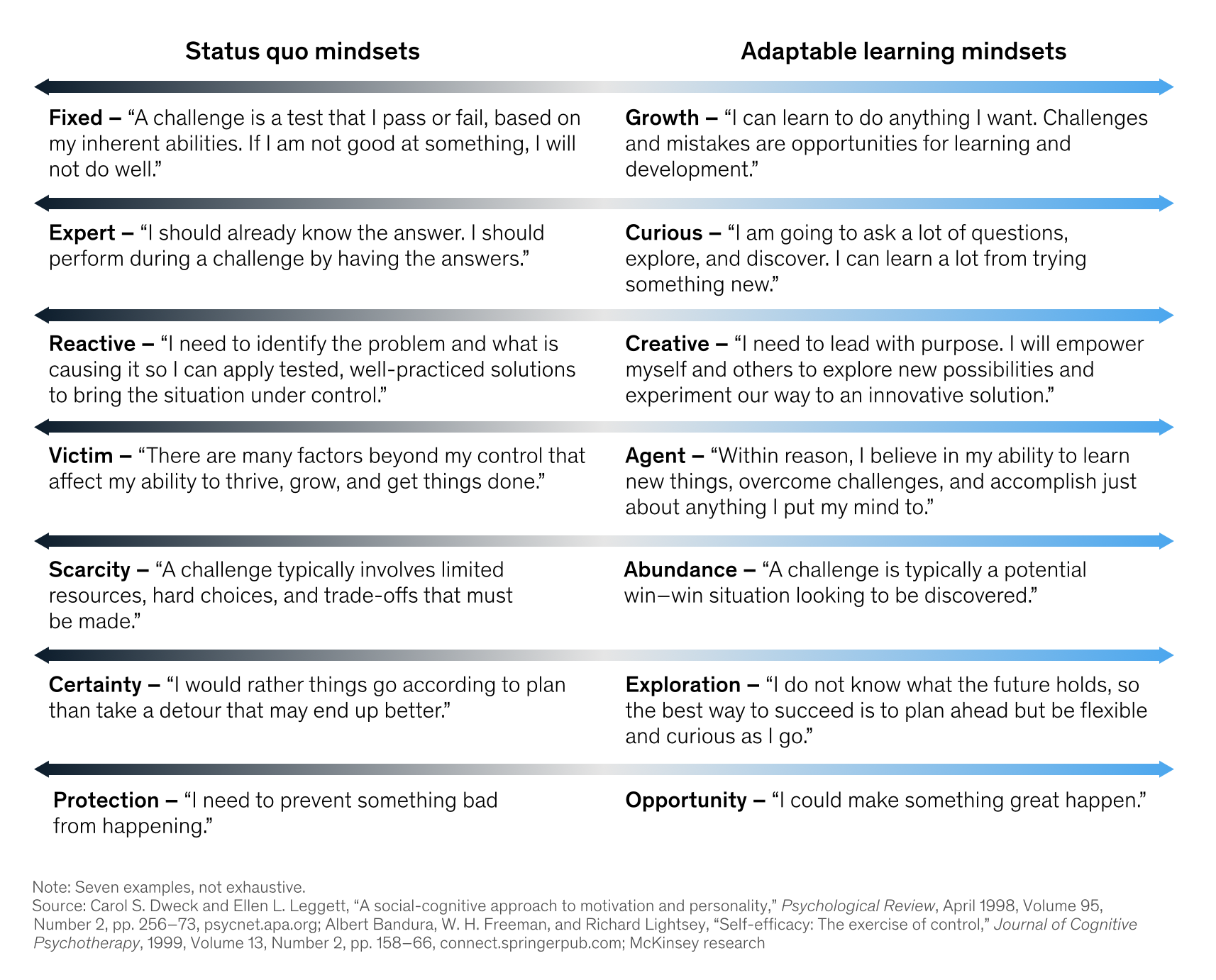
What “adaptive strategy” really means
Adaptive strategy is often misunderstood. It is not simply being flexible or agile. It is not improvisation. And it is not abandoning long-term thinking.
Adaptive strategy combines clear strategic intent with rapid, continual adjustment based on real-world feedback.
It rests on five principles:
-
Direction, not detailed prediction.
Organisations set a north star, strategic guardrails, and high-level priorities—but leave space for discovery and iteration. -
Short decision cycles.
Rather than annual plans, strategy is revisited monthly or quarterly in structured, evidence-driven conversations. -
Sense-and-respond behaviour.
Organisations invest in data, signals, and sensing systems to detect change early. -
Decentralised action.
Teams closest to the customer have authority to act, experiment, and reallocate resources within boundaries. -
Learning loops.
Every initiative becomes a source of insight, feeding back into strategy.
Crucially, adaptive strategy is neither top-down nor bottom-up. It relies on continuous interplay between the two. Leaders define ambition and guardrails; teams explore solutions and learn what works.
In this sense, adaptive strategy is less a document and more a living conversation—driven by evidence, shaped by learning, and updated in real time.
The Process
Although every organisation implements it differently, a common process has emerged across industries. It consists of five interlocking cycles.
1. Setting Strategic Intent
Adaptive strategy begins with clarity of direction. This includes:
-
Purpose: the organisation’s fundamental reason for being.
-
Ambition: where it seeks to create future value.
-
Strategic guardrails: what the organisation will and will not do.
-
High-level priorities: the big bets and areas of focus.
Unlike traditional strategy, intent is deliberately broad enough to guide yet open enough to permit iteration.
2. Sensing: Staying Connected to the World
Sensing is the continuous process of gathering signals from customers, markets, technology, competitors, and regulatory environments. It uses:
-
real-time dashboards
-
customer feedback loops
-
ethnographic research
-
horizon scanning
-
competitor radar
-
early-warning systems
-
cross-functional listening posts
The aim is not to predict the future but to detect shifts early enough to act—whether those are emerging customer needs, new digital behaviours, geopolitical risks, or competitor innovations.
3. Generating Options and Experiments
Based on insights from sensing, organisations generate options. Instead of committing to one grand plan, they explore multiple possible approaches via:
-
strategy sprints
-
horizon portfolios
-
hypothesis-driven initiatives
-
rapid prototyping
-
assumption testing
Each option is treated as an experiment designed to answer a question, reduce uncertainty, or validate an opportunity.
4. Execution Through Decentralised Teams
Rather than rigid program management, adaptive strategy relies on empowered teams who can:
-
act quickly without escalation
-
iterate solutions based on live feedback
-
adjust scope, resources, and timelines
-
collaborate across functions
-
kill or pivot ideas early
OKRs, agile methods, and autonomous teams become mechanisms for rapid learning.
5. Learning, Review, and Reallocation
Every cycle ends with reflection:
-
What have we learned?
-
What assumptions proved wrong?
-
Where do we double down?
-
What must we stop doing?
-
How should resources shift?
This creates a rhythm of strategic learning that replaces annual planning with a rolling, constantly refreshed approach.
The Tools
Adaptive strategy is enabled by a set of well-established tools and techniques. These include:
Tools for Strategic Intent
-
North Star Frameworks
-
Scenario Planning (future-back)
-
Strategic Guardrails
-
Portfolio Maps
-
Value Agendas
Tools for Sensing
-
Real-Time Customer Insight Platforms
-
Jobs-to-Be-Done Interviews
-
Market Trend Radars
-
Competitor Early-Warning Systems
-
Predictive Analytics
Tools for Exploration
-
Design Thinking
-
Strategy Sprints
-
Opportunity Portfolios
-
Hypothesis Mapping
-
Minimum Viable Business Models
Tools for Execution
-
OKRs with short cycles
-
Scrum, Kanban, or hybrid agile
-
Rapid decision protocols
-
Cross-functional squads and tribes
-
Continuous deployment in digital environments
Tools for Learning
-
Retrospectives
-
Experiment logs
-
Kill/continue/pivot gates
-
Business reviews every 4–6 weeks
-
Feedback dashboards
These tools matter not because they are fashionable, but because they enable organisations to move information, decisions, and resources at the speed required by modern markets.
Examples
Across the world, the organisations that outperform their peers are those that have embraced adaptive strategy not as a technique but as a way of operating. Here are some of the strongest examples.
Ping An: Adaptive Strategy at Ecosystem Scale
Ping An’s transformation from a traditional insurer into a digital-first, ecosystem-driven conglomerate is one of the most ambitious strategic evolutions of the past decade. Its model is built on continual sensing, experimentation, and rapid reallocation of resources.
How it works:
-
Strategy operates in 90-day cycles, with roadmaps refreshed quarterly.
-
Hundreds of micro-experiments run across health, smart cities, finance, and AI.
-
Real-time data from millions of users feeds directly into decisions.
-
New ventures such as Good Doctor, One Connect, and Autohome were created through iterative testing rather than long-term planning.
Impact:
-
Creation of multiple multibillion-dollar business lines outside core insurance.
-
Industry-leading return on equity.
-
A reputation as one of the world’s most innovative financial groups.
Ping An demonstrates adaptive strategy at scale: a continuously evolving ecosystem guided by data and learning.
DBS Bank: A Living, Learning Strategy Engine
DBS is widely regarded as the most advanced example of adaptive strategy in the global banking sector.
Approach:
- Defined a clear intent—“to make banking joyful”—but allowed teams to interpret it through local insights.
- Encouraged more than 10,000 experiments per year across the organisation.
- Used customer journeys as live strategic documents updated monthly.
- Replaced bureaucratic governance with light, fast learning loops.
- Integrated AI and data analytics into decision-making.
Impact:
- Became “World’s Best Bank” multiple times.
- Reduced cost-to-income ratio dramatically.
- Accelerated product innovation in wealth, SME, and retail banking.
- Created a culture where change is normal and experimentation is celebrated.
DBS turned strategy from a document into an engine—constantly in motion, learning, adjusting, improving.
BYD: The Masterclass in Fast-Cycle Strategic Allocation
China’s BYD is the fastest-moving large automobile and battery company in the world, and its strategy is inherently adaptive.
How BYD adapts:
-
Weekly technical reviews guide rapid product adjustments.
-
Vertical integration enables fast pivots—e.g., creating in-house chips during supply shortages.
-
Product cycles run much faster than Western competitors.
-
Frequent model updates respond immediately to real-time sales and feedback data.
Impact:
-
Became the world’s largest EV manufacturer.
-
Outpaced Tesla in China.
-
Entered new markets at record speed.
BYD thrives because it treats strategy as a continuous process, not a planning cycle.
Amazon: Strategy as Continuous Reinvention
Amazon has long rejected traditional planning. Jeff Bezos famously argued that most decisions should be “two-way doors”—reversible, temporary, and therefore not worthy of long analysis.
Adaptive mechanisms:
-
The “Working Backwards” process begins with the customer and leaves space for discovery.
-
Teams act autonomously within strategic guardrails.
-
Real-time metrics guide decisions.
-
Dozens of experiments happen simultaneously across devices, retail, cloud, logistics, and AI.
Outcomes:
-
AWS, Marketplace, Prime, Logistics, and Alexa were all outcomes of iterative exploration rather than top-down planning.
-
Amazon continually enters new categories before rivals can react.
Amazon shows that adaptive strategy is not a reaction to volatility—it is a generator of new growth.
Mercado Libre: Adaptive Scaling Across Latin America
Mercado Libre operates in one of the world’s most volatile regions. It succeeds because it adapts faster than its environment.
Key characteristics:
-
Rapid experimentation in payments, credit, shipping, and insurance.
-
Real-time adjustment to regulatory changes.
-
Decentralised teams customised to different national contexts.
-
Fast rollout of features based on user data.
Impact:
-
Largest technology company in Latin America.
-
Outperforms Amazon and local incumbents in multiple markets.
-
Created an integrated ecosystem of commerce, finance, logistics, and advertising.
Adaptive strategy allows Mercado Libre to flourish in conditions where slower organisations struggle.
Philips: Reinventing from Electronics to Health Tech
Philips’ transformation from a diversified electronics company into a focused health technology leader is an example of adaptive portfolio strategy.
How Philips adapts:
-
Uses scenario planning and strategic guardrails to steer long-term direction.
-
Runs continuous reviews to identify businesses to prune or scale.
-
Adjusts priorities based on technological, regulatory, and clinical trends.
-
Invests in digital health, imaging, connected care, and wearables based on real-time evidence.
Impact:
-
Exited more than 60% of its historical portfolio.
-
Created a coherent and competitive position in health systems.
-
Improved focus, margins, and long-term value creation.
Philips shows that adaptive strategy applies not only to innovation but to corporate restructuring and reinvention.
Schneider Electric: A Learning Loop for Climate and Energy Tech
Schneider Electric has evolved from a traditional industrial company into a digital-first energy management and automation leader.
Adaptive practices:
-
Uses strategy sprints to explore new sustainability and energy-tech opportunities.
-
Employs IoT and digital twins to sense performance in real time.
-
Allows cross-functional teams to adjust products continuously.
-
Uses agile governance to scale successful initiatives.
Results:
-
One of Europe’s most valuable industrial companies.
-
Rapid growth in software, services, and sustainability consulting.
-
Strong brand positioning in climate transition markets.
Schneider’s success demonstrates the power of adaptive strategy in large, complex industrial environments.
Spotify: The Cultural Expression of Adaptive Strategy
Spotify’s “squads and tribes” structure is famous, but it is only the visible surface of a deeper adaptive system.
How it operates:
-
Decentralised teams own problems end-to-end.
-
Data from millions of users drives weekly adjustments.
-
Features are tested continuously.
-
Organisational structure evolves as fast as the product.
Impact:
-
Constant innovation in personalisation, UI, podcasts, and audio learning.
-
Ability to outmanoeuvre larger competitors.
-
Rapid diversification into new audio categories.
Spotify shows that adaptive strategy is inseparable from culture. Empowered teams are not a technique; they are the philosophy in action.
The Difference
Adaptive strategy is not a marginal improvement. It reshapes the organisation at every level.
1. Adaptive strategy increases speed
Traditional strategy operates on annual cycles. Adaptive strategy operates on monthly or even weekly cycles. Decisions happen faster. Products evolve faster. Organisations respond to customers before competitors know what has changed.
2. Adaptive strategy enhances resource allocation
Resources move dynamically:
-
Away from declining areas.
-
Toward validated opportunities.
-
Into experiments with high potential.
-
Out of initiatives that no longer deserve support.
The organisation becomes more like a portfolio manager than a planner.
3. Adaptive strategy improves innovation
Because experimentation is continuous, the number of ideas tested grows dramatically. And because failures are cheap and early, more successful ideas reach scale.
4. Adaptive strategy reduces risks
Paradoxically, the more an organisation experiments, the safer it becomes. Early tests reveal weaknesses before money is wasted. Sensing detects threats before they become crises. Adaptive loops lower the cost of being wrong.
5. Adaptive strategy builds resilience
Adaptive organisations absorb shocks better. They are less rigid, less exposed to single points of failure, and less dependent on prediction. They treat uncertainty as normal and learn to thrive within it.
6. Adaptive strategy strengthens culture
Perhaps the most powerful difference is cultural. Adaptive strategy creates:
-
empowered teams
-
openness to learning
-
comfort with ambiguity
-
willingness to challenge assumptions
-
collaborative problem-solving
-
a bias for action
People feel ownership, autonomy, and pride. Organisations feel alive.
7. Adaptive strategy improves financial performance
Although the benefits are often cultural and organisational, they ultimately translate into commercial outcomes:
-
faster growth
-
better margins
-
stronger customer loyalty
-
improved return on capital
-
higher innovation revenue
-
sustained competitive advantage
Adaptive strategy is not a soft idea; it is a financial engine.
Strategy for a world in motion
The world has entered an era where traditional strategy cannot cope. Markets evolve too quickly. Technologies converge too unpredictably. Customer behaviour shifts too fast. Regulatory and geopolitical pressures emerge too suddenly. Competitive advantage comes less from size and assets, and more from speed of learning, willingness to adjust, and ability to act before rivals see what is happening.
In such a world, adaptive strategy is not optional. It is the new foundation for leadership and organisational excellence.
It is rooted in a deep understanding of how complex systems work. It draws from ecology, organisational learning, design thinking, agile methods, and modern digital practice. It replaces rigid planning with continuous sensing, experimentation, and learning. It balances ambition with humility, direction with discovery, judgement with evidence.
Most importantly, it restores strategy to what it truly should be: not a document, not a once-a-year ritual, but a continuous conversation about how to create value in a world that keeps moving.
Organisations that embrace adaptive strategy will not simply cope with change—they will shape it. They will grow faster, innovate more, and attract the best talent. They will be more resilient, more relevant, and more future-ready. They will develop a culture of curiosity, courage, and creativity.
And above all, they will rediscover that strategy is not about predicting the future but winning in the only world that exists: the one that changes every day.
More from the blog